

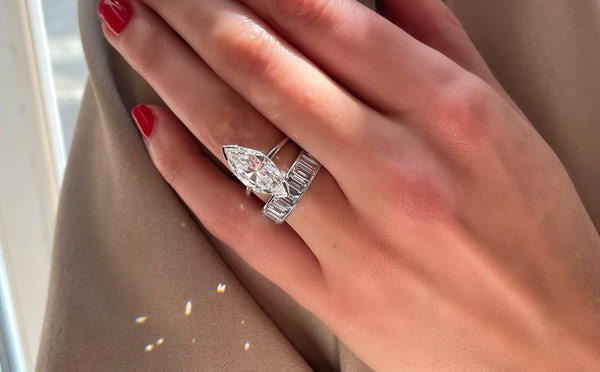
There was a time when marriage and a man's proposal immediately brought to mind diamond rings.
A symbol of love, a symbol of eternity, an essential item for proposals... However, these conventions are now completely shaken.
The reason the diamond resale market is nearly collapsing is more complex than expected, and it is the result of changes that have quietly accumulated over the past decade suddenly erupting.
First, the most critical change is the emergence of lab-grown diamonds.
Just ten years ago, lab-created diamonds were treated as "cheap imitations that look fake." But with explosive technological advancements, they have become so perfect that even gemologists cannot distinguish them without equipment. The same 1-carat diamond has the same brilliance and hardness, but is priced at less than half that of natural diamonds. In fact, during promotions, they can be as much as 70% cheaper.
In such a situation, what choice do consumers have?
"Why should I pay three times more for the same thing?"
This one question has completely disrupted the balance of the market.
As lab-grown diamonds have exploded in popularity, the resale prices of natural diamonds have plummeted.
If you try to resell a diamond a few years after marriage, in the past you could get '40-50% of the purchase price,' but now most places offer less than 30%. This is not because there are too many sellers, but because there are almost no buyers.
Moreover, the consumption patterns of the MZ generation are entirely different.
They do not trust the formula of "diamond=marriage=mandatory item" like their parents' generation. What matters is their lifestyle, values, and consumer satisfaction. Therefore, instead of expensive diamonds, there is a much stronger trend to substitute with moissanite from accessory brands, lab-grown diamonds, or gifts of travel, electronics, or cash.
The MZ generation especially dislikes the pretentious marketing of brands.
"This is a woman's eternal dream." "A man's worth is shown in diamond carats."
Such phrases actually provoke backlash.
They already know that the phrase 'diamonds are forever' is a 20th-century marketing gimmick.
In contrast, the boomer generation had a strong attachment to diamond rings. They were seen as symbols of the cost of marriage and proof of a husband's ability, and a 1.5-carat ring was considered the basic course of marriage.
However, the problem is that this generation is now in their 60s and 70s, and the time has come for them to liquidate their diamonds.
The number of items being put up for sale has exploded, but the number of buyers has decreased, lab-grown diamonds are overflowing, and the MZ generation places no value on natural diamonds.
In other words, demand has sharply decreased while supply has surged, leading to a collapse in prices.
Another important factor is that many young people today are delaying marriage or not getting married at all.
As marriage culture changes, the market for wedding rings has naturally shrunk. The trend of "couple rings are fine, but there's no need for diamonds" has become clear.
With women's economic power rising, the notion that "men must give women diamonds" has also become outdated. In an era where women themselves collect gold or gemstones, there is no reason to be fixated on diamonds. In fact, these days, the investment value of gold is more recognized.
Gold does not tarnish, there is no price collapse due to lab-grown alternatives, and it can be liquidated for nearly the purchase price when resold.
The core reason for the instability of diamond value is one:
The moment the myth that "diamonds are a woman's only gemstone" was shattered, their weight quickly diminished.
Ultimately, diamonds were a symbol created by the times, and the first thing to collapse when that symbol weakened was their resale value.
In the future, wedding rings will likely become more about "personal taste and meaning," and the status of diamonds may not return to what it once was.
It seems we have entered an era where diamonds are no longer essential for marriage but rather one of many choices.







 Korean Mom |
 novapixel |
 Peter Pan Pet |
 horse |
 Sunset Oregon |
 Alpha and Omega World |
 Yellow Snowman |
 draxen |
 SODA MAKER |
  Tonky |
  viroma |
  cookie |
  Live and that's it |
  Alright Twain |
  eatontown blog |
  HAWAII Korean Church News |
  Amore |
  linex |
  Balancework |
  laro90 |
  MEDBIO American Doctor Blog |
  SWAT TEAM BLK |
  DREAM BIG |
  frostbite |
  330 Forever My Love |
  El Dorado |
  dralix58 |
  Gorama Round |
  Skydiving |