
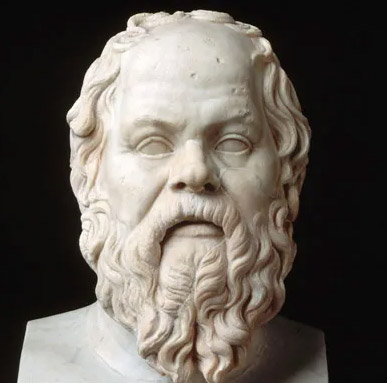
Socrates (470-399 BC) was an ancient Greek philosopher, known as the father of Western philosophy.
He is famous for his method of philosophical inquiry and for posing deep questions about human existence.
Socrates urged people towards 'self-awareness' through his philosophical explorations, leaving behind the famous quote, "Know thyself."
He emphasized that what is important in life is not external wealth or status, but understanding oneself and the inner truth.
Socrates employed the 'Socratic method' as a philosophical approach.
He engaged in conversations with others, questioning their beliefs or thoughts to prompt them to re-examine their knowledge or assumptions.
Through this, he aimed to clarify people's thoughts and reveal the contradictions they held.
This method is known as the 'Socratic method' and is considered one of the important learning methods in modern education.
Socrates is well-known for numerous philosophical anecdotes. Some of these famous stories illustrate his pursuit of philosophical truth.
One representative anecdote is the story of the "Delphic Oracle."
It is said that an oracle was delivered at the Temple of Apollo in Delphi.
The oracle stated that "Socrates is the wisest man."
Socrates did not believe this and could not accept that he was truly wise.
So, he went to others he knew and asked them how wise they were, discovering people he thought were wiser than himself.
However, they all believed they knew the truth, but in reality, many did not fully understand their own knowledge.
Socrates ultimately concluded that his wisdom stemmed from knowing that he did not know.
This anecdote emphasizes an important philosophical lesson that Socrates' wisdom is not merely about the quantity of knowledge, but about recognizing what one does not know.
Another famous anecdote relates to Socrates' trial.
In Athens, Socrates was put on trial for denying the gods and spreading false teachings to the youth.
Many people hated him at the time, but Socrates defended himself in court, convinced that he was following the right path regarding faith and morality.
He was not afraid of death, asserting that it was more important to fight for the truth.
Ultimately, he was sentenced to death and drank poison, leading to his demise.
This event is recorded as a historical fact that well illustrates Socrates' philosophical courage and obsession with truth.






 Weekend Movie Blog |
 Beauty, Health, Lifestyle Blog |

 coloradoman |
 Superman Cat Blog |
 Noodle Noodle |
  Tonky |
  viroma |
  cookie |
  Live and that's it |
  Alright Twain |
  eatontown blog |
  HAWAII Korean Church News |
  Amore |
  linex |
  Balancework |
  laro90 |
  MEDBIO American Doctor Blog |
  SWAT TEAM BLK |
  DREAM BIG |
  frostbite |
  330 Forever My Love |
  El Dorado |
  dralix58 |
  Gorama Round |
  Skydiving |