
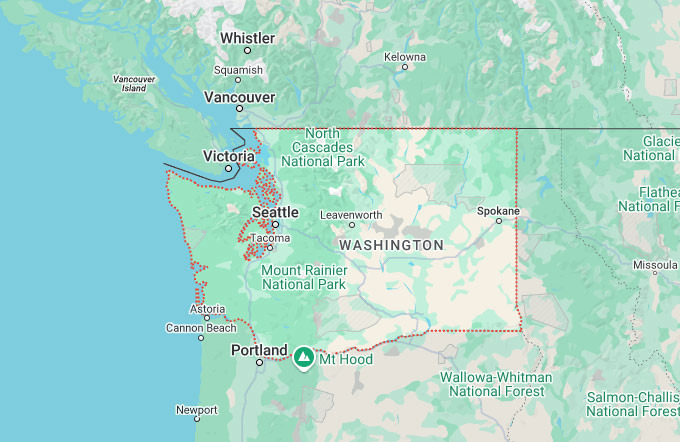
Washington State is a major transportation hub in the Pacific Northwest, with several major freeways running through the state, helping to connect regions. Here are the major freeways in Washington State and their features:
I-5 (Interstate 5)
- Length: Approximately 276 miles (444 km) within Washington State.
- Role: A major highway running north-south along the U.S. West Coast, connecting Washington State from the south (Oregon) to the north (Canada).
- Major Cities:
- Vancouver
- Olympia (capital)
- Tacoma
- Seattle
- Everett
- Bellingham
- Features:
- Passes through Seattle, the economic center of the state, with heavy traffic and congestion.
- Connects to British Columbia, Canada at the northern end.
I-90 (Interstate 90)
- Length: Approximately 297 miles (478 km) within Washington State.
- Role: The longest highway connecting the east-west axis of the U.S., starting from Seattle at the western end and extending eastward.
- Major Cities:
- Seattle
- Snoqualmie
- Ellensburg
- Moses Lake
- Spokane
- Features:
- Connects Seattle to Spokane and on to Idaho.
- A scenic highway that passes through Snoqualmie Pass.
I-405 (Interstate 405)
- Length: Approximately 30 miles (48 km).
- Role: Circles the eastern suburbs of Seattle and connects to I-5.
- Major Cities:
- Bellevue
- Kirkland
- Renton
- Bothell
- Features:
- An alternative route to reduce traffic congestion in Seattle.
- Passes through areas with major tech companies and suburban regions.
US Route 2
- Length: Approximately 326 miles (525 km) within Washington State.
- Role: A major road running east-west across northern Washington State.
- Major Cities:
- Everett
- Leavenworth
- Spokane
- Features:
- Famous for its scenic byway, passing through Stevens Pass.
- An important route connecting eastern and western Washington.
WA-520 (State Route 520)
- Length: Approximately 12 miles (19 km).
- Role: Connects Seattle to the Eastside region (Bellevue, Redmond).
- Features:
- The 520 Bridge crossing Lake Washington is one of the longest floating bridges in the world.
- Connects to Redmond, home to Microsoft headquarters.
I-82 (Interstate 82)
- Length: Approximately 144 miles (232 km).
- Role: A major highway in eastern Washington, starting from Yakima and connecting to Oregon.
- Major Cities:
- Yakima
- Richland
- Kennewick
- Features:
- Connects to the agricultural hub of Yakima Valley.
- Passes through the economic hub of the Tri-Cities (Richland, Kennewick, Pasco).
I-705 (Interstate 705)
- Length: Approximately 1.5 miles (2.4 km).
- Role: A short highway connecting downtown Tacoma to I-5.
- Features:
- An important road connecting downtown Tacoma and the port area.
These freeways connect the cities and regions of Washington State, playing a key role in the movement of residents and businesses.
In particular, I-5 and I-90 function as the backbone of the state's transportation network, making significant contributions to the state's economy and logistics.






 Bald Eagle Brothers |
 Bacon King Blog |
 PETRO Vatican Shrine |
 Seattle - Emerald City |
 Real Estate Agent USA |
  Tonky |
  viroma |
  cookie |
  Live and that's it |
  Alright Twain |
  eatontown blog |
  HAWAII Korean Church News |
  Amore |
  linex |
  Balancework |
  laro90 |
  MEDBIO American Doctor Blog |
  SWAT TEAM BLK |
  DREAM BIG |
  frostbite |
  330 Forever My Love |
  El Dorado |
  dralix58 |
  Gorama Round |
  Skydiving |