
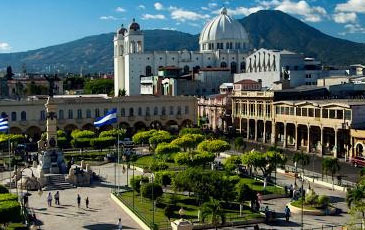
The Korean population in El Salvador is relatively small, with about 160 residents as of 2023.
After the Spanish conquest in the 16th century, El Salvador became a Spanish colony, economically dependent on agriculture, including cotton, balsam, and indigo. During this period, most of the land was owned by Spanish white elite families, and indigenous people were exploited as slaves. This structure deepened the severe inequality in Salvadoran society.
In 1811, a rebellion led by José Matías Delgado occurred but failed. Later, in 1821, El Salvador gained independence from Spain but was briefly part of Mexican territory before joining the Federal Republic of Central America in 1823. However, the federation was dissolved in 1838, and El Salvador became an independent nation. Most Central American countries adopted flag designs using blue and white to continue the legacy of the federation.
El Salvador experienced a history marred by civil war, dictatorship, and coups throughout the 20th century.
- 14-family rule: The landowner ruling system, a legacy of the Spanish colonial era, continued, with a small elite class monopolizing economic and political power.
- Football War (1969): Immigration issues and land disputes with Honduras erupted into war due to a football match.
- Military dictatorship: The military dominated politics throughout the mid-20th century, suppressing democracy. In 1972, they arrested the elected president and appointed a candidate put forth by the military as president.
The civil war resulted in extreme violence and massacres, leading to about 80,000 deaths and 500,000 people migrating abroad.
- Leftist guerrillas (FMLN): They fought against dictatorship and inequality, battling the military regime.
- U.S. intervention: During the Cold War, the U.S. provided economic and military support to the Salvadoran military to prevent the spread of leftism.
- Truth Commission: After the end of the civil war, investigations revealed that 95% of the violence was perpetrated by the government side (military, police, pro-government militias), while 5% was committed by the FMLN.
El Salvador established a democratic system after a long civil war, but economic inequality, security issues, and gang violence still threaten society. However, the Bukele government is pursuing change through reforms and the introduction of Bitcoin.
This country, with its complex history, retains a strong influence of the past on its current social and economic structures.






 Weekend Movie Blog |
 Beauty, Health, Lifestyle Blog |
 coloradoman |
 Superman Cat Blog |
 novapixel |
  US Embassy |
  Korean Mom |
  My NYC |
  moo moo |
  Mr Oh |
  forevergee |
  festival |
  manchester |
  constant |
  Leapfrog Move |
  vibranto |
  Tora Tora |
  yellowbutter |
  Dolly |
  NYC saladbar |
  Finding Superfoods |
  lightyear |
  song bang |
  vexomo |
  Indiana Jones |