

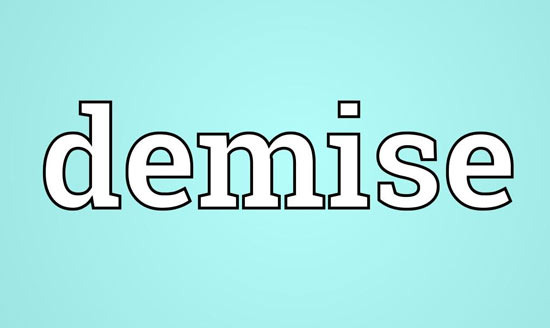
When memorizing English words, you often forget the less commonly used ones quickly.
In my case, the word "Demise" is exactly that. If you look it up in the dictionary, it says "death, end, downfall."
But if you memorize it like this, you will forget it 100%.
So, you need to memorize such words in a way that resonates with you.
The method I recommend is simple. "Demise = 시마이" You force yourself to memorize it with a similar word.
Why 시마이? The pronunciation of 디마이즈 and 시마이 feels similar. What does 시마이 mean? It means it's over. It's organized. It no longer exists. Game over.
Demise is the same. It conveys the feeling that a person, organization, or era has "come to an end."
Instead of saying "end" in a lofty way, just think, "Oh, this is 시마이"—that sticks much longer.
You don't need to complicate example sentences.
"The company met its demise." → That company has met its end. It means it went bankrupt.
"His sudden demise shocked everyone." → That man suddenly met his end, and everyone was surprised.
Officially, it's death, but when you visualize it, this is much quicker.

Why is this good? English is ultimately a battle of images.
It's about whether a scene comes to mind when you hear a word or not.
When you say "Demise = end," nothing comes to mind. It's just letters.
But when you say "Demise = 시마이," a scene immediately forms. The store closes, the lights go out, people leave, and it's over. That's it.
And even though this method may seem silly, it is definitely effective. Memory sticks better when it's tied to emotions.
"Demise = 시마이" is a bit twisted, so it sticks in your brain. On the other hand, "Demise = death, end" is too ordinary and just passes by.
That's what wins in practice. Demise is simply 시마이. It may seem forced, but that actually makes it more memorable.
Let me pick two more similar ones.
Eloquent = "일로 콰악트" someone who pushes through with words
It means persuasive, fluent in speech. If you memorize it in a dictionary way, it's boring and flies right out of your mind. So, "That person is pushing through with words." The image is of someone commanding the atmosphere with their speech. Their mouth is alive, words flow smoothly, and the listener is drawn in. That's what eloquent means. It's not just about speaking English well; it also conveys the feeling of being persuasive and smooth.
"She gave an eloquent speech." → She pushed through with her speech. This feeling won't be forgotten.
Meticulous = "매티 큐 없수" no gaps
It means careful, detail-oriented, obsessed with details. If you memorize it honestly, it won't last long. So, we go with "매티 큐 없수." There are no missing cues. There's no order that gets overlooked. No gaps. It sounds a bit strange, but this strangeness creates memory. This word applies to someone who doesn't do things half-heartedly but aligns everything, checks numbers, catches typos, and standardizes file names.
"He is meticulous about details." → That person doesn't miss any details. It's a level of meticulousness just before perfectionism.
While I'm at it, let's explore more.
Ephemeral = "에페메라? 페메라면 끝나버라" It lasts very briefly. Like fireworks. It sparkles for a moment and then ends.
"Fame can be ephemeral." → Popularity? It can end quickly.
Ambiguous = "앰비? 기스?" It means unclear or vague. It's a state where something seems to exist but isn't certain.
"His answer was ambiguous." → The answer is ambiguous. It scratches the surface and moves on.
Resilient = "리질리언트? tough and unyielding" It means having strong recovery ability, being elastic. It feels like bouncing back even when pressed like rubber.
"She is very resilient." → She is tough. She doesn't break.
Scrutinize = "스크류 나이즈" It means to examine closely. It's not just looking; it's taking apart the screws to see everything.
"They scrutinized the report." → They took it apart and examined everything.
Tedious = "테디우스? 테디베어처럼 늘어짐" It means boring and repetitive. It feels like time isn't passing.
"This task is tedious." → This is really dragging on. I don't want to do it.
Lucid = "루시드? 루시처럼 맑음" It means clear and distinct. A state that is clean without any blur.
"He gave a lucid explanation." → The explanation is clear. It's easy to understand.
Candid = "캔디드? 사탕처럼 솔직함" It means honest and straightforward. A style that doesn't beat around the bush.
"She was candid about it." → She just laid it all out honestly.
Implicit = "임플리싯? 말 안 해도 포함됨" It means implicit. The meaning is included without being explicitly stated.
"It was implicit." → It's already implied without needing to say it.
Redundant = "리던던트? 이미 한 거 또 던짐" It means unnecessarily repetitive. It's redundant.
"This sentence is redundant." → It's already been said again.
Viable = "바이블? 살릴 수 있음" It means feasible. It's in a state where it can survive and not die.
"This plan is viable." → This can be salvaged. It works.
Memorizing like this is good because when you actually speak, it comes out immediately. Words memorized in a dictionary way don't come out.
You have to translate in your head first, but by then, the conversation has already moved on. But with these, they stick with the image, so when the situation arises, they come out automatically.
For those who read this to the end, even if you think it's nonsense, you probably picked up a few words today.







 eatontown blog |
 Toaster Pizza Magic Show |
 US Embassy |
 fortbliss |
 Folding Instructions |
 Purple Moons, |
 Kathy's Blog |
 What can make money? |

 Tonky |
  viroma |
  cookie |
  Live and that's it |
  Alright Twain |
  HAWAII Korean Church News |
  Amore |
  linex |
  Balancework |
  laro90 |
  MEDBIO American Doctor Blog |
  SWAT TEAM BLK |
  DREAM BIG |
  frostbite |
  330 Forever My Love |
  El Dorado |
  dralix58 |
  Gorama Round |
  Skydiving |