

In the market, regular American rice brands are about $1 per pound on sale, while premium rice like glutinous rice can jump to around $2 per pound. So, a 15-pound bag of regular rice costs about $15, while premium rice is around $30.
But during times of skyrocketing prices, how much would one actually lose if they ate HMR rice for all three meals a day?
I became curious and did the math myself. Even if it seems unnecessary, having this realistic calculation can be quite helpful when making choices later.
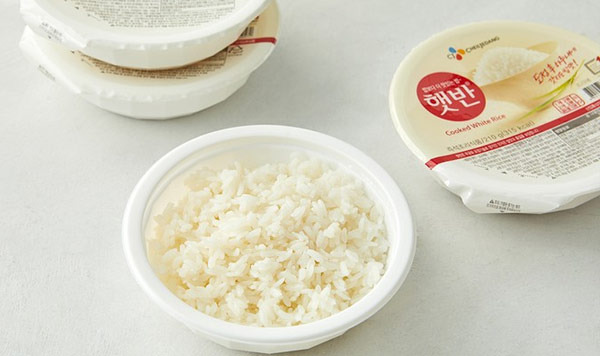
First, let's organize some basic information. The rice in one HMR package is exactly 100g based on raw rice.
And the most common price in the market is $22 for a pack of 12. So, that makes it about $1.83 per package. Of course, after sales tax, it goes up a bit, but let's just say it's $1.83 per package.
Thinking of it simply as eating rice worth about $1.83 per meal feels quite expensive. Considering the current exchange rate, one HMR package costs about 3,000 won.
On the other hand, if you buy regular rice and cook it in a rice cooker at home, the difference in cost is significant.
Currently, a 15-pound bag of rice at a Korean market costs about $15. When converted by weight, that's 6,800g, and dividing the price gives about $0.0022 per gram, which is about 22 cents for 100g.
Since one HMR package costs $1.83, based on the same 100g, HMR is about 8.3 times more expensive than cooking rice yourself.
I suspected it would be somewhat expensive, but seeing the number 8 is surprisingly high. Ultimately, it seems that the cost of HMR is mostly for packaging and convenience.
Now, let's calculate the annual cost for an adult male eating all three meals with HMR.
Typically, an adult consumes about 300g of raw rice per day. That's about 100g per meal.
So, the annual rice requirement would be 300g × 365 days = 109,500g, or about 110kg. This translates to needing 1,100 packages of HMR, each 100g.
1,100 packages × $1.833 = about $2,016. So, if one eats only HMR for a year, the cost of rice alone would be around $2,000.
In contrast, the price for 110kg of regular rice, based on the earlier price of $15 for 6.8kg, would be about $243.
For the same amount of rice, HMR costs a whopping $2,016, while cooking rice at home costs $243. The difference between the two is about $1,773.
That means one would spend over $1,700 more on packaged rice in a year. When broken down daily, that's about $4.8, or an extra $1.6 per meal.
Of course, HMR is convenient. It only takes 1 minute and 30 seconds in the microwave, and there's no need for dishes, which is a huge advantage for busy people.
However, when you look at the actual costs, you can really feel how expensive the "price of convenience" is. The idea that cooking rice for 3-4 days at a time in a rice cooker is much more economical didn't come from nowhere.
In conclusion, relying solely on HMR for three meals leads to wasting nearly $1,800 a year just for the sake of convenience.
At the very least, cooking rice at home and freezing leftovers to reheat later would be a good habit to save money.







 eatontown blog |
 Toaster Pizza Magic Show |
 US Embassy |
 fortbliss |
 Folding Instructions |
 Your Curiosity Resolved |
 LIZ Legal Information Blog |

 Jean Claude Bundang Blog |
 Nuchuhan Exploration BLOG |
  Tonky |
  viroma |
  cookie |
  Live and that's it |
  Alright Twain |
  HAWAII Korean Church News |
  Amore |
  linex |
  Balancework |
  laro90 |
  MEDBIO American Doctor Blog |
  SWAT TEAM BLK |
  DREAM BIG |
  frostbite |
  330 Forever My Love |
  El Dorado |
  dralix58 |
  Gorama Round |
  Skydiving |