

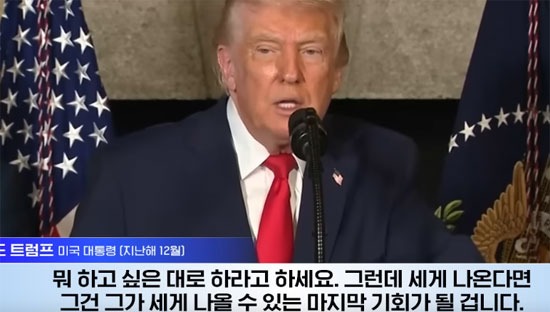
The U.S. military's surprise airstrike on Venezuela on the 3rd local time, resulting in the capture and extradition of President Nicolás Maduro to the U.S., has shocked the world. Particularly, President Donald Trump stated that it was an operation to bring the "illegal dictator Maduro to justice," sparking heated debate within the U.S.
Initial assessments suggest that the operation was successful. While the official justification was the crackdown on drug trafficking, experts mention the possibility of more complex motivations at play.
During a press conference, President Trump announced that Maduro and his wife, Cilia Flores, were indicted in the Southern District of New York on serious drug trafficking charges targeting the U.S. This indictment has been in progress since March 2020 during Trump's first administration, focusing on drug trafficking and money laundering allegations. The U.S. government emphasizes the legitimacy of Maduro's arrest based on this.
However, currently, the leading cause of drug-related deaths in the U.S. is not cocaine from Venezuela, but fentanyl from China and Mexico. This naturally raises the question of why now, and why Venezuela.
It remains unclear whether this operation is solely about drug trafficking or if it has a strong character of regime change. Former National Security Advisor John Bolton stated, "It is unclear whether this is about illegal drugs or regime change."
In fact, the Trump administration attempted to oust Maduro in 2019. At that time, the Venezuelan opposition appointed Juan Guaidó as the leader against the regime, but it failed, and the U.S. publicly supported Guaidó. At that time, foreign media interpreted that the U.S. was involved in plans for regime change in Venezuela.
Strategic Importance of Oil, the Country with the Largest Reserves
Another reason Venezuela is in the spotlight is that it has the largest oil reserves in the world. Estimated at about 303 billion barrels, this reserve is theoretically the highest level globally, but actual production is only about 860,000 barrels per day, less than a third of what it was ten years ago. This is due to the exodus of skilled labor and equipment under the control of the state-owned oil company PDVSA.
Meanwhile, President Trump emphasized during the press conference that "American oil companies were chased away after investing in Venezuela in the past," stating that they would rebuild Venezuela's oil industry. This is framed as a justification to "revive Venezuela's oil industry," but there are interpretations suggesting it aims to restore favorable conditions for American companies.
Trump stated, "The Venezuelan oil business has been completely destroyed for a long time," and asserted that American oil companies would generate profits in the country with billions of dollars in investments. While the government officially speaks of "reconstruction for the Venezuelan people," there are analyses suggesting that economic motives for the recovery and expansion of American corporate interests are also evident.
International Law Controversy
The issue is that all these processes cannot avoid controversy over international law. The act of capturing and extraditing a sitting head of state from another country's territory is rare and a highly sensitive matter. Therefore, the international community is closely monitoring this issue, and debates continue over whether the U.S. actions violate international law.
Trump officially cited drug trafficking as the reason for Maduro's capture this time. However, looking at the actual drug death statistics in the U.S., fentanyl coming from China and Mexico appears to be a much more serious problem than cocaine from Venezuela. This has led to interpretations within the U.S. that "it may not just be about drugs." Among politicians and experts, there is a strong analysis that the objective of regime change is likely included in this operation to some extent.
Finally, this incident has sparked controversy over violations of international law and is drawing the attention of the international community. The very act of capturing and extraditing a sitting head of state from another country's territory is highly unusual, leading to ongoing global debates about whether the U.S. actions align with international norms. All these elements combined make this incident not just a simple criminal investigation but a complex international political event.






 Moscow Kim |
 coloradoman |
 Montgomery Mom |
 GOGO SING |
 Hajiwon Blog Hair Salon |
 Cherokee Rose |
 Dingho and USA News |
 Let's Be Like a Salt-like City Person |
 Gimmi207 Blog |
 moonshine 7 |
  Tora Tora |
  yellowbutter |
  Dolly |
  US Embassy |
  NYC saladbar |
  Finding Superfoods |
  lightyear |
  song bang |
  vexomo |
  Indiana Jones |
  meloncat |
  novapixel |
  mortrix |
  Esther 1983 |
  fortbliss |
  My Two Way |
  toastyfox |
  FLORIDA Acus |
  tracker |