
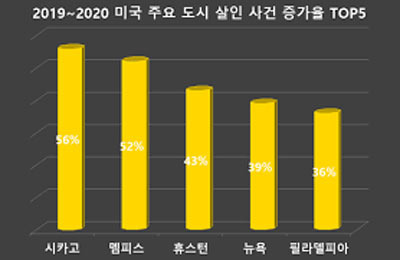
Chicago is known as one of the cities with a high crime rate in the United States.
As of 2020, Chicago's crime rate was 3,926 incidents per 100,000 people, which is 67% higher than the national average.
In particular, in 2020, there were a total of 26,620 violent crimes, including 774 homicides.
Several factors contribute to Chicago's high crime rate.
First, there are about 55 criminal organizations with 117,000 members active in Chicago, which is about nine times the police force. The activities of these criminal organizations significantly impact the rise in crime rates within the city.
Second, the increase in retirements and resignations among police officers has been pointed out as a problem leading to a decrease in police strength. Many officers are leaving Chicago due to poor working conditions and low morale, which negatively affects crime prevention and response.
There are several complex reasons behind the increase in retirements among Chicago police officers. Many officers leave the job or transfer to other areas due to poor working conditions and high stress levels.
John Catanzara, president of the Chicago Police Union, pointed out that "12-hour shifts, canceled days off, and constant disciplinary threats" are major complaints among officers. In particular, it has become common for even young officers to leave the job before qualifying for retirement benefits. They tend to choose leave or transfer to other cities before finding new jobs.
Additionally, there are criticisms that the police-related comments made by Chicago's Democratic Mayor Lori Lightfoot have demoralized the police force. Officers feel they are not respected enough, leading to a stronger motivation to transfer to other cities for better working conditions. Ray Lopez, the alderman of Chicago's 15th ward, emphasized that "many cases of police officers leaving Chicago are appearing as transfers to other areas."
These issues signify more than just a loss of personnel. The decrease in police strength can directly impact the management of crime rates and the maintenance of public safety in Chicago, making the improvement of working conditions and the enhancement of social respect for officers important tasks.
Third, certain areas of Chicago, particularly the South and West sides, experience heightened crime rates due to economic hardship and social inequality. In these areas, the murder rate can be up to 20 times higher than in other regions.
These complex factors contribute to Chicago's high crime rate, and addressing them requires economic, social, and institutional approaches.








 Khan Film Blog Production |
 Illinois Mom |
 Rice Shop Uncle BLOG |
 Enjoyable American Life Diary |
 allstar realty |
  laro90 |
  MEDBIO American Doctor Blog |
  SWAT TEAM BLK |
  DREAM BIG |
  frostbite |
  330 Forever My Love |
  El Dorado |
  dralix58 |
  Gorama Round |
  Skydiving |
  dreamport |
  Yellow Snowman |
  Toaster Pizza Magic Show |
  velvetnom |
  Anytime Journey |
  Mrs. Duluth |
  jaxter |
  Atlanta Mama |
  Baguette Blog |
  Tan Sol |