
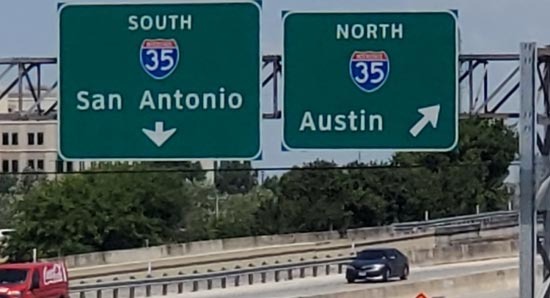
San Antonio and Austin feel very close when you look at a map. The straight distance is about 80 miles, and it takes about 1 hour and 30 minutes by car.
Depending on the time of day, it varies slightly, but taking I-35 makes it relatively easy to travel between the two cities. Therefore, there are quite a few people who commute between the two cities or work in Austin during the week and return to San Antonio on weekends.
Austin is a hub for high technology and startups, while San Antonio is strong in military, medical, and educational industries.
Because the industrial structures of these two cities are different, some people choose to work for tech companies in Austin while opting for the lower cost of living in San Antonio. Conversely, there are also those who work in public institutions or hospitals in San Antonio while keeping their families in the suburbs of Austin.
However, realistically, commuting is not as easy as it seems. The I-35 corridor is one of the most congested roads in Texas. Especially between 7 AM and 9 AM and 5 PM and 7 PM on weekdays, cars are lined up for a long distance. The direction heading towards Austin tends to be congested during morning rush hours, while the opposite direction towards San Antonio often faces traffic during evening rush hours.
As a result, most commuters choose to leave early in the morning or adopt a hybrid work model where they only go to the office 2-3 days a week. Nowadays, due to the high housing prices in Austin, many workers endure the inconvenience of commuting and live in the outskirts of San Antonio.
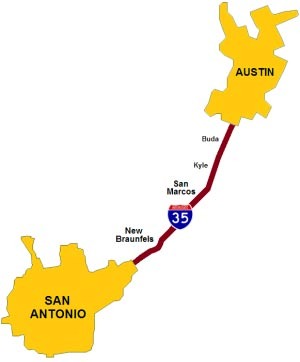
People living in areas like Stone Oak, Schertz, or New Braunfels say that commuting to Austin is feasible. This distance can be covered in about 60-70 minutes, and on weekends, it can take less than an hour without traffic.
Thus, the real estate market in this area is often referred to as "a town suitable for Austin workers." Conversely, suburban areas like Buda or Kyle to the south of Austin are also popular as they are balanced locations for commuting to either city.
Currently, there are no high-speed trains or direct trains connecting the two cities. Instead, using intercity buses like Greyhound or FlixBus allows for travel in about an hour and a half with several departures throughout the day. However, for regular commuting, using a personal vehicle is much more practical.
The common reason for people commuting from San Antonio to Austin ultimately boils down to 'quality of life for the cost.'
While it is difficult to cope with the skyrocketing housing prices and cost of living in Austin, jobs are still concentrated there. In San Antonio, one can enjoy a much larger home and a more comfortable living environment for the same budget. Even if commuting is a bit challenging, they choose a life where they can host barbecue parties in their front yard every weekend.
Conversely, there are also people who live in Austin and commute to work in San Antonio. Particularly, those working in the medical, military, and public sectors find many job opportunities in San Antonio and have families in Austin, commuting daily or using accommodations in San Antonio during the week. This lifestyle pattern is entirely feasible in terms of distance.
Ultimately, San Antonio and Austin are 'close yet distant cities.' On the map, they are an hour apart, but during rush hours, they can feel far away. However, as the two cities become more connected and transportation infrastructure improves, the commuting environment will also get better.
In fact, the Texas state government is gradually carrying out expansion work on I-35, and long-term plans for a railway connecting the two cities are also under consideration.
Therefore, what is most needed for those traveling between these two cities right now is patience and planning. Realistic adjustments like early morning commutes and flexible working hours, along with the hope that traffic will improve someday.








 Helpful Life Stories |
 American Man in a Mask |
 Hajiwon Blog Hair Salon |
 Make My Day |
 TEXAS Fishing Boat |
  Anytime Journey |
  Mrs. Duluth |
  jaxter |
  Atlanta Mama |
  Baguette Blog |
  US Embassy |
  Korean Mom |
  My NYC |
  moo moo |
  Mr Oh |
  forevergee |
  festival |
  manchester |
  constant |
  Leapfrog Move |
  vibranto |
  Tora Tora |
  yellowbutter |
  Dolly |
  NYC saladbar |