
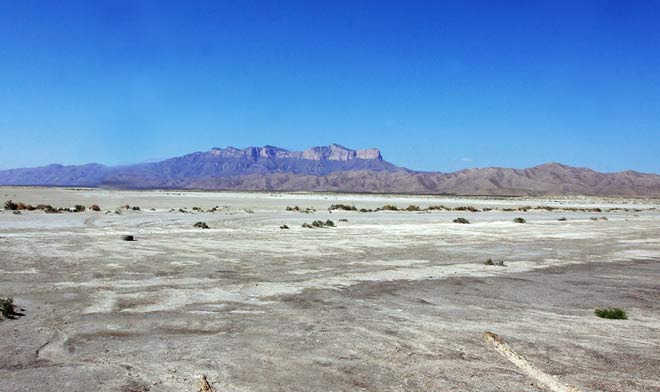
When people think of Texas, many envision green pastures and cowboys, but in reality, Texas has a unique terrain known as the High Plains (High Plains, Edwards Plateau, Trans-Pecos, etc.).
In the map of Texas, as you move to the west and northwest, the land becomes increasingly flat, dry, and sparsely vegetated, giving a desolate feeling.
People living in cities may not feel it, but the High Plains are actually an environment that is not easy for humans to inhabit.
First, looking at the elevation, the Texas High Plains range from 1,500 to 2,500 feet (450 to 760 m), and as you go west, it rises further to reach 3,000 to 4,000 feet (900 to 1,200 m).
The highest point in Texas, Guadalupe Peak, reaches 8,749 feet (2667 m). As the elevation increases, the air becomes drier and the temperature variation becomes greater. It can be scorching hot during the day but drops significantly at night. In summer, temperatures can exceed 100 degrees (37 degrees Celsius), and in winter, they can drop below freezing, making life challenging due to these extreme temperature changes.
Rainfall is also scarce. There are many areas where the annual precipitation is only 10 to 20 inches (250 to 500 mm). When it doesn't rain, the ground hardens, making it difficult to raise livestock. Therefore, grazing has developed more than farming in the High Plains.
To irrigate land where only grass grows to cultivate crops is costly, and groundwater often has to be accessed at great depths. Water is a precious resource in Texas, and especially in the High Plains, water is a lifeline. Sometimes, drilling a well requires going down thousands of feet.
The vegetation is also unique. Junipers, mesquite, and cacti dominate, and the grasslands are sparsely covered with buffalo grass swaying in the wind. This landscape can sometimes appear more suited for cattle or wildlife than for human habitation. As a result, large residential areas are difficult to form, and the distances between cities are far, requiring long drives. Traveling through West Texas, you may not see a town for an hour.
There are mountains, but landscapes resembling 'exposed rocky hills' are common, and there are many caves and cliffs, making it a paradise for explorers. However, these elements can be inconvenient for daily life. Strong winds and hard soil make it difficult to establish an agricultural base, and the harsh climate poses challenges for settlement.
The Texas High Plains offer a starry sky unseen in cities, and the endless horizon and desolate landscapes provide a strange sense of awe. The nature is less touched by human hands, and with many national and state parks, camping, trekking, and rock climbing are popular activities. Places like Big Bend National Park, though barren, captivate travelers with their overwhelming scale.
In conclusion, the Texas High Plains are high, dry, and not easy for humans to live in.
However, the nature is rugged and beautiful, showcasing another face of Texas that is completely different from the cities.






 Helpful Life Stories |
 American Man in a Mask |
 Hajiwon Blog Hair Salon |
 Make My Day |
 TEXAS Fishing Boat |
  Anytime Journey |
  Mrs. Duluth |
  jaxter |
  Atlanta Mama |
  Baguette Blog |
  US Embassy |
  Korean Mom |
  My NYC |
  moo moo |
  Mr Oh |
  forevergee |
  festival |
  manchester |
  constant |
  Leapfrog Move |
  vibranto |
  Tora Tora |
  yellowbutter |
  Dolly |
  NYC saladbar |