

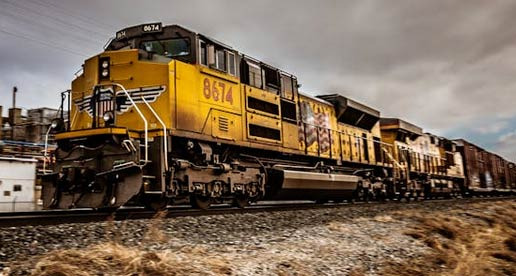
There is a landscape you will inevitably encounter while driving long distances from San Antonio.
With a ding ding ding~ warning sound, the barrier is down, and a freight train stretches endlessly alongside the road, with a yellow locomotive roaring at the front. When seen up close, its massive size appears even more overwhelming than expected.
The most commonly seen type of freight train near San Antonio is the container train.
Imported goods coming from the port city of Houston or the Gulf of Mexico are mainly transported by these trains. The next most common are trains carrying petrochemical products, grains, steel, and auto parts.
The logistics flow from refineries or agricultural warehouses in the southern region to the central and western areas almost all pass through this route. Additionally, there are several rail yards and junctions near San Antonio, where you can often see freight trains stopping or being reconfigured on the outskirts of the city.
For example, the Eagle Pass line or Laredo line of Union Pacific is a major route for cross-border trade, with trains running almost continuously. Therefore, you can often hear the sound of horns from afar, both during the day and at dawn. A prime example is the Union Pacific Railroad, which, as the company that built the transcontinental railroad, still holds the throne of freight railroads.
The yellow color is highly visible, reducing accidents, and it harmonizes well with the earth and the sun. However, the real charm lies in its 'power.' Typically, the cars we drive have about 200 horsepower, but a yellow locomotive has around 6,000 horsepower.
It produces the power equivalent to 30 cars at once. However, American freight trains use this by coupling 3 to 4 locomotives together, resulting in a total of over 18,000 horsepower.
It's like putting almost fighter jet engine power into a train engine. As for the length... it usually exceeds 1.5 km, and can be as long as 3 km.
Its weight can exceed 20,000 tons. These yellow giants are what push and pull this weight.
So, how much fuel do they consume? Surprisingly, they are incredibly efficient.
According to the Association of American Railroads, freight trains can transport about 480 ton-miles per gallon.
In simple terms, it means moving 480 tons of cargo for 1 mile on 1 gallon of diesel.
Since large trucks typically operate at around 130 to 150 ton-miles, trains are three times more efficient.
Thanks to this fuel efficiency, American logistics still centers around railroads.
Every year, billions of tons of coal, grain, oil, cars, and containers move not by road but by rail.
This helps reduce the congestion of trucks on the roads and significantly lowers carbon emissions.
This locomotive is a diesel-electric engine, where the engine drives a generator, and that electricity powers the motors.
This results in an incredible torque capable of pulling heavy loads.
Nowadays, hybrid concepts are also being introduced, utilizing batteries and automatically adjusting engine efficiency, making them smarter.
When you see that yellow train running on the highway, think of the history, power, and fuel efficiency it embodies.
Its gleaming appearance in the sunlight, the heavy yet rhythmic sound, the massive horn...
That is like the heartbeat of the country known as America.







 Helpful Life Stories |
 American Man in a Mask |
 Hajiwon Blog Hair Salon |
 Make My Day |
 TEXAS Fishing Boat |
  DREAM BIG |
  frostbite |
  330 Forever My Love |
  El Dorado |
  dralix58 |
  Gorama Round |
  Skydiving |
  dreamport |
  Yellow Snowman |
  Toaster Pizza Magic Show |
  velvetnom |
  Anytime Journey |
  Mrs. Duluth |
  jaxter |
  Atlanta Mama |
  Baguette Blog |
  Tan Sol |
  US Embassy |
  Korean Mom |
  My NYC |