

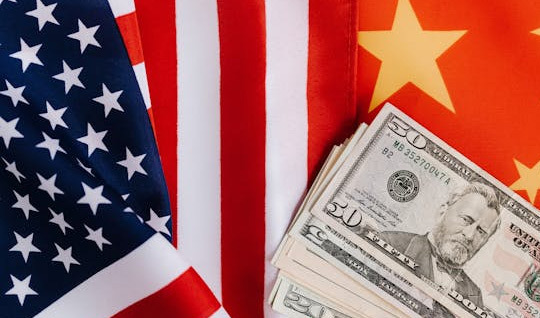
The economic friction between the United States and China has actually been ongoing for a long time, but it can be said that the term "trade war" began to be used around 2018. At that time, the United States started imposing high tariffs on Chinese products, leading both sides to exchange tariff bombs.
2018 Trade War
As the United States imposed high tariffs on Chinese imports, China retaliated with counter-tariffs on American products, escalating the conflict. In particular, the competition for technological supremacy in the semiconductor and tech sectors accelerated, becoming a key issue that continues to this day.
Technological Supremacy Competition
In key advanced industries such as 5G, AI, and semiconductors, the United States' efforts to curb China's rapid growth became prominent. Issues such as the mandatory transfer of technology from foreign companies and intellectual property rights began to resurface, leading to a reevaluation of the investment risks for American companies in China.
Recent Trends
On the surface, it seemed that tariffs were being lowered or that a "Phase One Deal" was being reached, temporarily sealing the situation. However, the Biden administration's stance on curbing China has not significantly changed. Recently, export controls and investment restrictions in advanced sectors such as semiconductors and batteries have become issues, expanding the friction between the two countries beyond a simple "tariff war" to the level of "supply chain risk."
So how does this conflict affect the dollar exchange rate? The biggest factor can be seen as "risk-off sentiment." When the global economy becomes unstable, investors tend to seek the dollar, which is considered relatively safe, leading to a strengthening of the dollar.
Dollar Value Increase (Bullish Pressure)
When international disputes or trade frictions intensify, the dollar is recognized as one of the "safe assets," attracting investors. This movement becomes more complex when intertwined with the Federal Reserve's interest rate policies, but fundamentally, as global economic instability increases, the trend of bullish pressure on the dollar often appears.
Chinese Yuan Exchange Rate
If the Chinese economy is hit, there is a greater possibility that investment funds will flee from the Chinese capital market, which could lead to a depreciation of the yuan. On the other hand, the Chinese government sometimes implements various policies (market interventions, interest rate adjustments, etc.) to stabilize the exchange rate at a certain level, making the actual flow of exchange rates very complex.
Impact on International Trade and Supply Chains
As tariffs and technology sanctions between the US and China increase, global companies are accelerating their moves to diversify supply chains from China to Southeast Asia or India (the so-called "China Plus One" strategy). Such changes will increase demand for the currencies of those regions in the long term and, conversely, may affect the relationship between the yuan and the dollar.
Recent Dollar Exchange Rate Trends
During 2022-2023, the US Federal Reserve sharply raised interest rates to curb inflation, resulting in an overall strengthening of the dollar. When interest rates rise, the preference for dollar assets such as US bonds or deposits increases, leading to a strengthening of the dollar.
Signals of Changes in Interest Rate Policy
Recently, there are expectations that inflation may ease somewhat, and concerns about a slowdown in the US economy have led to speculation that the Fed may halt or slow down interest rate hikes. If this scenario materializes, the trend of the dollar becoming too strong may be curtailed.
Possibility of US-China Diplomatic Normalization?
When news comes that the leaders of the two countries may ease tensions through talks, market sentiment tends to relax, temporarily stabilizing the dollar's strength. However, conversely, if news arises about additional measures such as sanctions or export controls, investors may flock back to the dollar, increasing volatility.
US-China economic friction is not just an issue limited to the two countries, but a matter that has significant repercussions for the global economy. And that impact directly affects the dollar exchange rate, stock and bond markets, and commodity prices in a chain reaction.If the conflict enters a resolution phase, it could be a positive signal for exchange rate stability, but for the time being, various variables are intertwined, making dramatic resolution seem unlikely. Therefore, it is crucial to continuously monitor news trends, economic indicators, and the Fed's monetary policy.
In the future, while keeping an eye on the fluctuations in US-China relations and the dollar exchange rate, it is advisable to make appropriate preparations based on your economic situation or investment plans.







 El Dorado |
 lightyear |
 Moscow Kim |
 coloradoman |
 Montgomery Mom |
 newyorker 101 |
 Things to Do to Buy a House |
 U.S. Weather Bureau News |
 International Court |
 NYC saladbar |
  Tonky |
  viroma |
  cookie |
  Live and that's it |
  Alright Twain |
  eatontown blog |
  HAWAII Korean Church News |
  Amore |
  linex |
  Balancework |
  laro90 |
  MEDBIO American Doctor Blog |
  SWAT TEAM BLK |
  DREAM BIG |
  frostbite |
  330 Forever My Love |
  dralix58 |
  Gorama Round |
  Skydiving |