
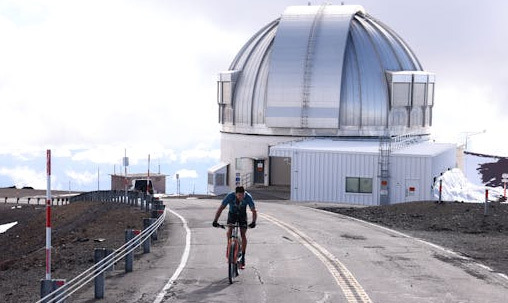
When people think of Hawaii's Big Island, they often first imagine flowing lava or beautiful beaches, but this place is also famous as one of the world's top astronomical observation sites. With clear skies and low light pollution, large observatories are gathered here. Today, I will briefly summarize the information about the observatories on the Big Island, especially those located on Mauna Kea.
Location and Features
Mauna Kea is a massive dormant volcano with an elevation of about 4,200 meters, and the area near the summit is above the clouds, resulting in low humidity and clear air. At night, the stars seem to pour down, and the stable atmosphere provides optimal conditions for telescope observations. It boasts a special position as an astronomical observation site, attracting astronomers from around the world for research.
Observatories
W. M. Keck Observatory: Home to the Keck I and Keck II telescopes, which are among the largest optical and infrared telescopes in the world. They use massive mirrors to observe deep space.
Subaru Telescope: Operated by the National Astronomical Observatory of Japan, this telescope has an aperture of 8.2 meters and is known for its sharp imaging capabilities.
Gemini North Telescope: The Gemini project has large telescopes located in both the Northern Hemisphere (Hawaii) and the Southern Hemisphere (Chile). It conducts various observational studies in the optical and infrared domains.
Canada-France-Hawaii Telescope (CFHT): Although it may appear relatively small with a 3.6-meter aperture, it has a long history and a solid record of observations. Various teams from national astronomical institutions and universities collaborate to operate this large telescope.
Visiting and Tour Information
Mauna Kea Summit Tours: There are day tours operated by professional tour companies. Due to the high elevation and low pressure, those who are not feeling well should consider their health conditions.
Visitor Information Station (VIS): For those who find it difficult to reach the summit, this center allows visitors to observe stars and enjoy related exhibits and souvenirs. Located at about 2,800 meters, it offers a more comfortable experience.
Caution for Personal Vehicle Use: If you do not have a four-wheel drive vehicle, it may be difficult to reach near the summit, and altitude sickness should be taken into account. Taking a tour is safer and more convenient.
Issues at Mauna Kea
Environmental and Cultural Issues: Native Hawaiians consider this mountain sacred, leading to conflicts surrounding the construction of new telescopes (especially the Thirty Meter Telescope, TMT). There is ongoing debate between the need to respect local culture and traditions and the necessity for advancements in astronomy. The state government of Hawaii, observatories, and indigenous groups are working together to implement various efforts, such as regulating nighttime lighting to prevent light pollution and limiting telescope expansions.
Hawaii's Big Island is a unique place where you can enjoy both relaxation and astronomical wonders. Thanks to the high and clear skies, world-class observatories are gathered here, and anyone can experience the mysteries of the universe through sunset and stargazing tours. Of course, it is also important to consider the natural environment and indigenous culture, so please remember to follow related guides and regulations for a safe and enjoyable visit.







 victoria 68 |
 Hawaii Tourist Information |

 HAWAII Korean Church News |
 TEX MEX STAR |
  Tonky |
  viroma |
  cookie |
  Live and that's it |
  Alright Twain |
  eatontown blog |
  Amore |
  linex |
  Balancework |
  laro90 |
  MEDBIO American Doctor Blog |
  SWAT TEAM BLK |
  DREAM BIG |
  frostbite |
  330 Forever My Love |
  El Dorado |
  dralix58 |
  Gorama Round |
  Skydiving |