

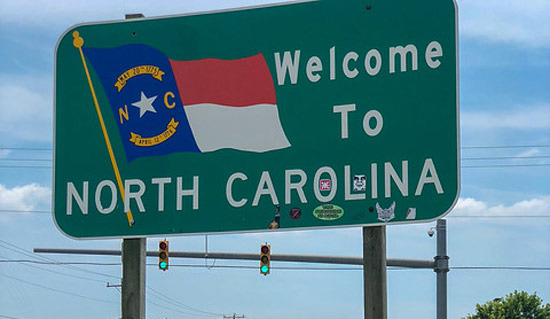
North Carolina was once famous for its tobacco and textile industries, but it has now grown into a state with a completely different industrial structure.
It can be said to be a balanced state where traditional industries, advanced technology, agriculture, and urban economies are evenly mixed.
When talking about North Carolina's economy, the most frequently mentioned place is the 'Research Triangle'.
The name comes from the triangular shape formed by the three cities of Raleigh, Durham, and Chapel Hill, and this area has developed into one of the leading centers for advanced industries in the United States. Prestigious universities such as Duke University, North Carolina State University, and UNC are located here, and as research institutes and startups have emerged around these universities, the IT, pharmaceutical, biotech, and data industries have rapidly grown.
However, North Carolina's economy does not rely solely on the technology industry. The eastern region is still primarily agricultural, producing major crops such as tobacco, corn, soybeans, and pork. In particular, the pork industry boasts a top-tier scale within the United States. Moving to the western part of the state, the grape cultivation, wine, and craft beer industries are well-developed.
Cities like Asheville are famous for craft beer and attract many tourists. This way, industries vary by region, allowing the overall economy to remain stable without leaning towards one side.
Charlotte is another pillar of North Carolina's economy. As the largest financial city in the Southeast, it is regarded as the second-largest financial center after New York. The headquarters of Bank of America is located here, and major banks like Wells Fargo also operate branches. As a result, there are many jobs related to finance, insurance, and accounting, and recently, fintech startups have been emerging actively.
In addition, the automotive parts, machinery, furniture, and aerospace industries are evenly distributed. High Point is known as the 'Furniture Capital of the World', with a vibrant interior-related industry, and an international furniture fair is held annually, attracting buyers from around the globe.
North Carolina is also considered a great state for business. With low corporate taxes, ample land, and well-developed transportation infrastructure, it is favorable for attracting companies. Major highways stretch across the state, and there are several airports, making logistics movement easy. Thanks to this environment, electric vehicle and battery-related companies are establishing factories, and manufacturing jobs are rapidly increasing.
Another important point is that the cost of living is low. Compared to California or New York, housing prices are lower, and the cost of living is less burdensome. For this reason, young professionals and tech talents are moving in, leading to population influx that drives consumption and economic growth. The tourism industry also plays a significant role in the economy.
The Blue Ridge Parkway in the western Appalachian Mountains is considered one of the most beautiful drives in America, while the eastern Wilmington and Outer Banks coastal areas are popular vacation spots.
Thus, North Carolina's economy has a structure that grows evenly across advanced technology, finance, manufacturing, agriculture, and tourism, remaining resilient even in downturns. It is a state that does not lose its innovation amidst the relaxed atmosphere unique to the South, and a place where nature and urban life are in balance.







 ultron78 |
 garlic bread |
 Sugar Cream Door Bulletproof Noodles |
 urbanmint |
 |
| 
 NC Dreamer |
  Audio Mania World |

 Balan |
 North Carolina State University |
  manchester |
  constant |
  Leapfrog Move |
  vibranto |
  Tora Tora |
  yellowbutter |
  Dolly |
  US Embassy |
  NYC saladbar |
  Finding Superfoods |
  lightyear |
  song bang |
  vexomo |
  Indiana Jones |
  meloncat |
  novapixel |
  mortrix |
  Esther 1983 |
  fortbliss |
  Moscow Kim |