

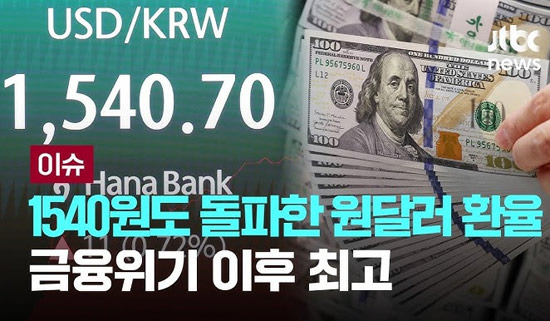
Wow, this is really crazy.
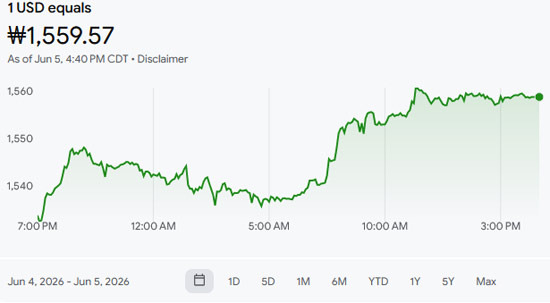
As of June 5, 2026, the dollar exchange rate has surpassed 1,559 won per dollar.
This is the highest level since the entire country was in a panic during the global financial crisis in 2009. It's a record that hasn't been seen in 17 years and 3 months.
What's even more surprising is that this is not during an IMF currency crisis or the Lehman Brothers incident.
South Korean banks are not collapsing, and people are not lining up on the streets to buy dollars.
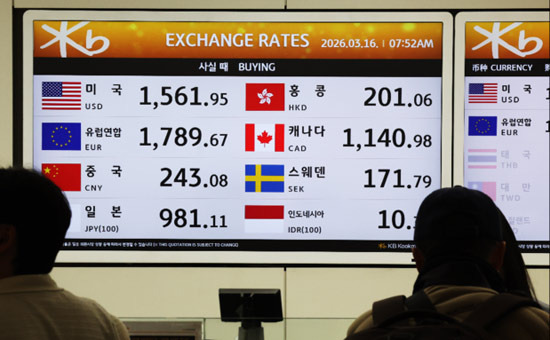
Yet, the exchange rate is showing signs of a systemic crisis. Right now, if you want to buy dollars at Incheon Airport, it costs 1,600 won.
In the past, if you sent 10,000 dollars from the U.S., you would receive about 12 million won in Korea, but now it's just over 15 million won.
It's like suddenly getting more than 3 million won for sending the same amount of money.
For those earning dollars in the U.S., it honestly makes you question, "Is this right?" every time you exchange.
On the other hand, people coming to the U.S. from Korea are sighing.
A hotel in the U.S. that costs 300 dollars used to feel like about 350,000 won, but now it's nearly 470,000 won.
A family dinner in the U.S. with tips easily exceeds 200,000 won.
These days, investors are in a mode of "I don't want adventure; safety is the best."
U.S. Treasury bonds offer high interest rates, and the dollar remains the strongest currency in the world. Global funds are flocking to the dollar.
On top of that, Korea is facing structural issues like low birth rates, an aging population, and slow growth.
From a foreign investor's perspective, they see, "Korea is a good country, but right now, the U.S. looks safer."
The exchange rate is not just a simple number. It's a voting result showing where global money trusts more.
And right now, the market is speaking quite coldly.
"Sorry, but right now, the dollar is more trustworthy than the won."
The result is the number 1,559 won per dollar.
In short, the current exchange rate makes you think, "Isn't this a bit too much?"
Korea is a country that exports semiconductors and cars, isn't that strange?
That's right. That's why many people feel like "something is off."
Logically, Korea is a manufacturing powerhouse with the 10th largest economy in the world, exporting semiconductors and cars.
So, according to the textbook, a country strong in exports should see its currency value maintained due to the influx of foreign currency.
But right now, several factors are overlapping.
The first is that the U.S. is too strong.
In the past, when Korea did well, the won would strengthen, but now it's more important to consider "How strong is the U.S.?" rather than "Is Korea doing well?"
Since over 60% of global funds move based on the dollar, when U.S. interest rates are high, money flows into the U.S.
The second is that while Korean companies are doing well, the overall Korean economy is not as good as expected.
For example, Samsung Electronics and Hyundai Motors are doing well, but
- the world's lowest birth rate
- population decline
- aging population
- domestic recession
- real estate burdens
The same issues continue to persist.
From an investor's perspective, they are asking,
"Samsung is good, but what about the whole of Korea?"
The third is that the export structure is different from before.
In the past, when export payments came to Korea, a lot of won had to be bought.
But now, global companies have many overseas factories and subsidiaries.
Hyundai Motors produces in the U.S., and
Samsung has production facilities in Texas and several other countries.
It's not a structure where all dollars come into Korea like before.
The fourth is the Korea Discount issue in the stock market.
From a foreign investor's perspective, stocks in the U.S., Japan, and India often look more attractive.
So even if Korean companies perform well, the foreign funds entering the stock market are limited.
Cynically speaking, the current situation reflects the evaluation that
"Samsung Electronics and Hyundai Motors are world-class, but it's easier for investors to buy U.S. Treasury bonds than their stocks."
That's why many economists believe that the current exchange rate reflects that "it's not that the Korean economy is failing, but that the dollar is too strong."
 LegoJellyMon
 SnowSummit
 YogurtAI
 DomainToday







 Swift Falcon |
 Tonky |
 My NYC |
 coloradoman |
 Living Economy Information Blog |
 Weekend Movie Blog |
 Beauty, Health, Lifestyle Blog |
 Victory 1988 |

 Superman Cat Blog |
  Augusta Univ |
  B.I.G. Victor |
  venture |
  SPAM 101 |
  choi family |
  zoryan |
  cloud0 |
  SKy Face |
  wonder |
  Dragon Lee |
  productionblog |
  What can make money? |
  Oklahoma Hoya OK |
  prixon74 |
  Roman Pan |
  USALATU BLOG |
  Sunshine Blog |
  Minnesota Small Business |