

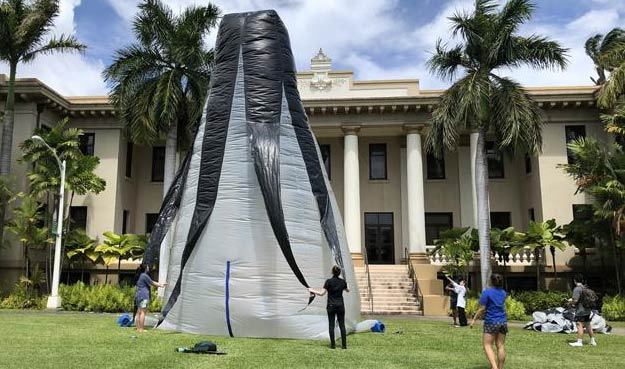
The University of Hawaii at Mānoa is a public research university located in Honolulu, Hawaii, and serves as a leading institution of higher education in the Pacific region. It is globally recognized for its unique geographical location, multicultural environment, and strengths in marine, environmental, and Asia-Pacific research.
Established in 1907, the University of Hawaii at Mānoa began with a focus on agricultural and mechanical education. As Hawaii developed into a significant Pacific hub for the United States, the university also grew rapidly. It expanded into a comprehensive university and now serves as the flagship campus of the University of Hawaii system, playing a central role in education and research.
Currently, approximately 19,000 students are enrolled, with a balanced offering of undergraduate and graduate programs. The student body is highly international, with a significant proportion of international students from countries in the Pacific region, including the U.S. mainland, Japan, Korea, China, Southeast Asia, and Oceania. This environment provides favorable conditions for diverse cultural experiences and the formation of a global network.
The admission competitiveness is moderate, but popular majors and Honors programs attract many academically strong applicants. The student-to-faculty ratio is relatively stable, and a notable advantage is that undergraduates have many opportunities to participate in faculty research projects, despite being a large research university.
The faculty is actively engaged in research across various fields, consistent with its status as a research-focused university. The University of Hawaii at Mānoa is classified as an R1 institution by Carnegie, indicating the highest level of research activity, and receives federal research funding in areas such as oceanography, climate change, volcanology, astronomy, life sciences, and public health. Notably, field research leveraging Hawaii's geographical characteristics is actively conducted.
The most recognized fields at this university are marine and earth sciences. The School of Ocean and Earth Science and Technology (SOEST) is highly regarded globally in marine science, marine biology, meteorology, geology, and climate research. Its location in the middle of the Pacific provides an optimal environment for marine observation and climate change research.
Astronomy and space science are also significant strengths of the University of Hawaii at Mānoa. Research is conducted in collaboration with the Mauna Kea Observatory, yielding international research achievements in astrophysics and space observation.
Additionally, research on Asia and the Pacific region is an important characteristic of this university. The Asian Studies and Pacific Islands Studies programs comprehensively study language, history, politics, economics, and culture, boasting a high level of recognition within the United States. Fields such as international relations, international business, and tourism management are also competitive, reflecting Hawaii's regional characteristics.
The Shidler College of Business is recognized for its strengths in international business and Asian market research. Hawaii's role as an economic gateway between Asia and the U.S. translates into educational and employment opportunities.
Alumni of the University of Hawaii at Mānoa are active in various fields, including politics, academia, environmental research, public institutions, the tourism industry, and international business. The influence of the university's alumni network is particularly strong in Hawaii's state government, local public institutions, and the tourism and aviation industries. Additionally, many graduates work in the Pacific region and Asian countries, forming an international alumni network.
The campus environment is characterized by a harmonious blend of nature and urban life. The Koʻolau mountain range is located behind the campus, and Waikiki Beach is nearby, allowing students to continue their studies in a beautiful natural setting. The mild climate year-round and an outdoor-oriented lifestyle contribute to high student satisfaction on campus. The NCAA Division I Rainbow Warriors sports team and various student clubs are also actively engaged.
Overall, the University of Hawaii at Mānoa is a research-focused university with global competitiveness in marine, environmental, earth sciences, and Asia-Pacific studies. It is considered a highly attractive option for students looking to engage in global fields, based on its multicultural environment, international research network, and unique geographical advantages.







 Magic Cabbage School of Martial Arts |
 Vacation on Hawaii |
 morvex37 |
 Ari Songhan American Immigration Life |
 Bearded Strawberry Smoothie |
 victoria 68 |
 Hawaii Tourist Information |
 HAWAII Korean Church News |
 TEX MEX STAR |
  Tonky |
  viroma |
  cookie |
  Live and that's it |
  Alright Twain |
  eatontown blog |
  Amore |
  linex |
  Balancework |
  laro90 |
  MEDBIO American Doctor Blog |
  SWAT TEAM BLK |
  DREAM BIG |
  frostbite |
  330 Forever My Love |
  El Dorado |
  dralix58 |
  Gorama Round |
  Skydiving |