

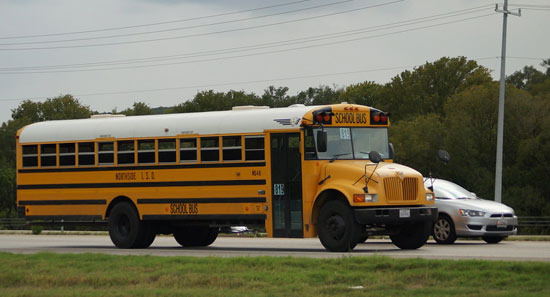
The yellow school buses in Texas are not just vehicles that transport children. In a vast place like Texas, transporting hundreds of thousands of children daily without accidents is almost like a national project.
Therefore, these buses can be seen as not just a means of transportation, but rather as small fortresses rolling down the road. As of 2026, Texas school buses are well-organized into a massive system encompassing history, technology, and the working conditions of drivers.
The beginning was very humble. In the early 1900s, rural children had to travel several dozen kilometers to school, and at that time, the only means of transportation was a horse-drawn school wagon. It wasn't until the 1920s that buses with engines began to appear, which, by today's standards, were almost just trucks with wooden boxes on top, making their safety quite questionable.
Then, in 1939, school bus standards were unified across the United States, establishing the yellow color we now recognize as National School Bus Yellow. Texas applied these standards particularly strictly, and as a massive independent education system took root, school buses became a core infrastructure of educational administration.
When you see a school bus rolling around Texas, you can immediately understand why people say they resemble tanks. The entire bus is constructed of steel, and it is designed so that the roof does not easily collapse even if it rolls over. The seats are not just ordinary chairs; they are made with thick structures that absorb shock, ensuring that children are protected between the seats in case of an accident.
The floor is also much higher than that of a regular passenger car, so if a collision occurs from the side, the impact is directed towards the frame rather than at the height where the children are seated. Therefore, when asked what the safest vehicle in America is, many people will confidently say it is the school bus.
Driving such monstrous buses is not something just anyone can do. Drivers must be at least 21 years old and have a clean driving record. They need to obtain a CDL Class B commercial driver's license and additionally receive a school bus and passenger transport badge. They must pass annual physical exams, drug tests, and criminal background checks, and they are hired either directly by the school district or by specialized transportation companies. Essentially, it can be seen as a quasi-public servant level of management.
As of 2026, the treatment of drivers has improved significantly compared to the past. In major Texas cities, hourly wages range from $22 to $30, and they increase further for those who handle special education buses or have more experience. Working hours are divided into morning and afternoon shifts, allowing for plenty of free time during the day, making it particularly popular among retirees or those looking for side jobs.
If they are part of the school district, they also receive health insurance and are included in the Texas teacher retirement system, providing a high level of stability. Nowadays, due to a shortage of drivers, many areas even offer sign-on bonuses. Thus, the yellow school buses of Texas are not just a means of transportation; they symbolize the safety of children and the trust of the community, and their drivers are respected as an important profession in the area.




 Magic Cabbage School of Martial Arts |
 Vacation on Hawaii |
 morvex37 |
 Ari Songhan American Immigration Life |
 Bearded Strawberry Smoothie |
 xylora |
 Aura-Infused WACAM |
 wendra |
 There Are Such Things in the World |
 US Embassy |
  Korean Mom |
  My NYC |
  moo moo |
  Mr Oh |
  forevergee |
  festival |
  manchester |
  constant |
  Leapfrog Move |
  vibranto |
  Tora Tora |
  yellowbutter |
  Dolly |
  NYC saladbar |
  Finding Superfoods |
  lightyear |
  song bang |
  vexomo |
  Indiana Jones |