

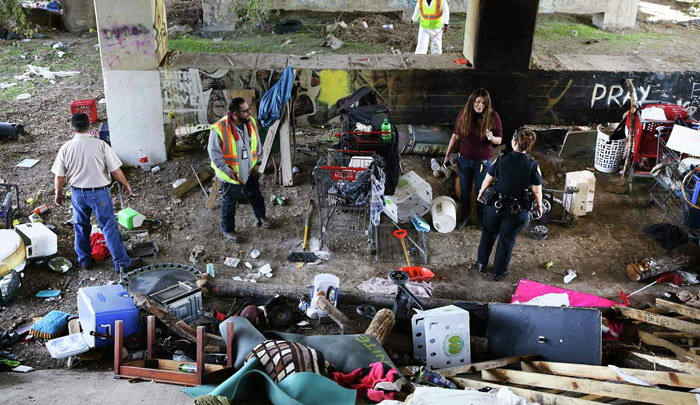
The state of Texas has vast land, but it also experiences extreme climate change.
In the summer, temperatures often exceed 100 degrees, while in winter, frigid winds can drop temperatures below freezing, and sudden heavy rains can occur, followed by weeks of drought that can crack the ground.
Because of this climate, air conditioning is essential, and in winter, it is difficult to live without heating, so the situation is not as dire as California, where the streets are filled with homeless people.
Of course, there are also active (?) Texas state government policies regarding homelessness, and the vast land helps to somewhat disperse the issue.
But does that mean there are no homeless people in Texas? Not at all. Just in Dallas, where I live, you can occasionally see people living in tents under freeway overpasses or near downtown.
The same goes for other urban areas like Houston, San Antonio, and Austin. Especially in Austin, which has many music festivals and a free-spirited atmosphere, the homeless population is more noticeable.
In contrast to the somewhat harsh Texas, Southern California is milder even in winter, making it relatively easier to live on the streets.
This is why the rate of homelessness is said to be high. The Los Angeles area, which is frequently in the news, is one of the regions with the highest homeless population in the country, where tent cities are a common sight on the streets. The high cost of housing, extreme rent increases, and state-level social welfare policies are significant factors contributing to the rise in homelessness.
On the other hand, Texas maintains a relatively affordable housing environment, and the tax structure is different, so the numbers are not as overwhelming as in Los Angeles.
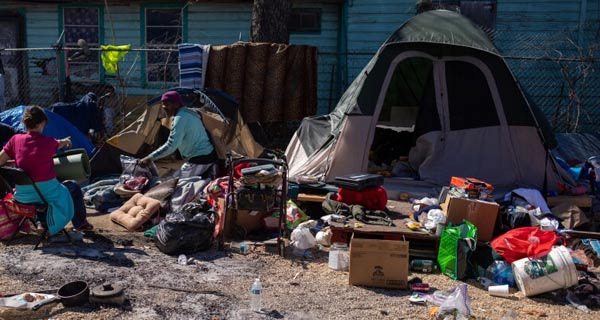
Simply comparing, it is said that in the Los Angeles area, there is about 1 homeless person for every 100 people, while in Texas's major urban areas, there is about 1 homeless person for every 400 people.
This is a simple comparison for averaging, and there are areas in Texas's gated communities where homeless people are hardly found.
The differences in homelessness between Texas and California are also evident in policy directions.
California emphasizes a human rights and welfare-centered approach, yet in reality, homeless camps are spread throughout the cities, often giving the appearance of being 'neglected.'
In contrast, Texas has a strong emphasis on public order and safety, so rather than large tent cities forming in urban areas, police and city authorities often control and disperse them. Texas police do enforce regulations on the homeless.
Thus, the homeless in Texas are not concentrated like in Los Angeles; they are relatively dispersed or often alternate between living on the streets and in shelters.
The causes of homelessness in Texas stem from limited support for low-income individuals and insufficient mental health treatment or drug recovery programs, leading to a vicious cycle of homelessness. Once someone becomes homeless, it is incredibly difficult to return to stability. Relationships with family or relatives are often severed, and without an address, finding a job is challenging, ultimately leading to reliance on government support or volunteer organizations again.
So what is the Texas state government doing? They are running temporary housing programs in conjunction with HUD (U.S. Department of Housing and Urban Development) across the state, and there are movements to expand homeless shelters and food support centers in each city.
In Dallas, for example, they are implementing a "Housing First" model, providing housing first and then connecting individuals to job training or medical support.
Houston is one of the cities that has seen significant success with this model, with statistics showing that they have reduced the homeless population by nearly half over the past decade.
Of course, it is not a 100% solution, and there are still many people fighting against the cold or heat on the streets. Especially during summer days exceeding 100 degrees, many people collapse from heatstroke, and during winter cold snaps, there are cases of fires occurring in tent cities due to heaters being used.
Living in Dallas, the tent cities I see every day on my commute are not just scenery; they remind me that it is a problem our society has yet to solve.
There is a saying, "Everything is bigger in Texas," but we must not forget that if we neglect the homelessness issue, it can become a big problem as well.




 xylora |
 wendra |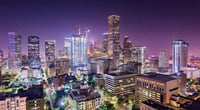
 Texas Migration Story |
 ultron78 |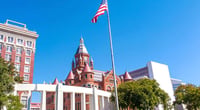
 Aura-Infused WACAM |
  Tonky |
  viroma |
  cookie |
  Live and that's it |
  Alright Twain |
  eatontown blog |
  HAWAII Korean Church News |
  Amore |
  linex |
  Balancework |
  laro90 |
  MEDBIO American Doctor Blog |
  SWAT TEAM BLK |
  DREAM BIG |
  frostbite |
  330 Forever My Love |
  El Dorado |
  dralix58 |
  Gorama Round |
  Skydiving |