

When we look up at the night sky and say, "Wow, the stars are beautiful," we are only seeing a small part of the universe.
The universe emits all kinds of electromagnetic waves. Among them, the equipment that captures radio waves to study space is called a radio telescope.
When we think of telescopes, we usually think of "seeing," but radio telescopes are more about "listening."
They capture and analyze very faint signals sent from space. The universe shown by radio telescopes is a completely different world.
The first thing that catches your eye when you see a radio telescope is the huge dish-shaped antenna.
This is called a parabolic reflector, which is essentially a large version of a satellite dish antenna.
It serves to collect the weak radio waves coming from space into a single point.
But why does it need to be so large? Because the radio waves coming from space are extremely weak.
The radio waves emitted from galaxies, pulsars, and gas near black holes arrive at Earth at almost noise level.
So, by making the dish larger, we can gather as many signals as possible to capture them.
The collected radio waves then go to a receiver located at the center or top of the dish.
There, the radio waves are converted into electrical signals, but the problem is that these signals are very weak.
So, amplifiers are used, but if they generate heat, noise occurs, so they are cooled down to extremely low temperatures using something like liquid helium.
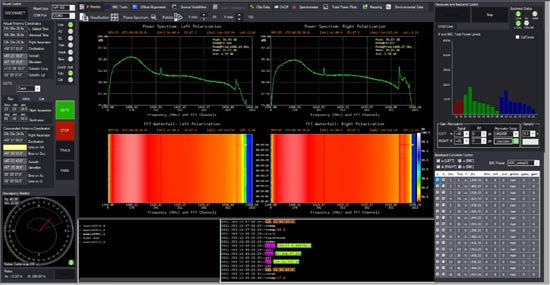
Finally, the amplified signals are received by a computer, which performs spectrum analysis and converts them into images.
The images of radio telescopes that we see are all created through calculations.
The biggest advantage is that we can see things that are absolutely invisible to the naked eye.
There is much more gas in the universe than stars. In particular, hydrogen atoms emit radio waves at a wavelength of 21 cm, and by capturing this, we can map the structure of our galaxy.
Additionally, neutron stars emit radio waves like a lighthouse as they spin rapidly, which are known as pulsars.
By precisely measuring the signal period with a radio telescope, we can study extreme physical phenomena. While we can't see black holes directly, we can detect the radio jets emitted from them and infer that "Ah, there is a black hole active here." We can also measure the faint radio signals left over from the Big Bang to estimate what the early universe was like.
Radio waves have long wavelengths, so using just one dish results in lower resolution. Therefore, scientists have come up with a method to place multiple dishes thousands of kilometers apart to observe the same thing simultaneously and then combine the signals.
This is called interferometry, and it allows us to achieve the effect of using a telescope the size of the Earth. The Event Horizon Telescope (EHT), which took the famous black hole shadow photo, used this method.
Radio waves can penetrate dust and gas well. Therefore, we can see the centers of galaxies, star-forming regions, and supernova remnants that are obscured from view by regular telescopes. Moreover, it works during the day, on cloudy days, and is not affected by light pollution.
We tend to think that what we see is all there is to the universe, but the universe shown by radio telescopes is a completely different world. Even if the sky seems quiet, the universe continues to send signals, and radio telescopes gather those faint whispers to read the history of the universe.
Thus, radio telescopes are not just observational instruments; they can be considered a massive ear listening to the invisible world of the universe.







 novapixel |
 Peter Pan Pet |
 horse |
 Sunset Oregon |
 daisypat |
 Star Way |
 CA Real Estate |
 some fame |
 Choi Cho |
 manchester |
  constant |
  Leapfrog Move |
  vibranto |
  Tora Tora |
  yellowbutter |
  Dolly |
  US Embassy |
  NYC saladbar |
  Finding Superfoods |
  lightyear |
  song bang |
  vexomo |
  Indiana Jones |
  meloncat |
  mortrix |
  Esther 1983 |
  fortbliss |
  Moscow Kim |