

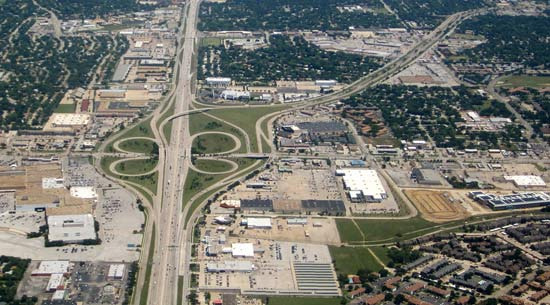
Located in the heart between Dallas and Fort Worth, Irving appears to be a quiet suburban city on the surface, but it actually has a quite dynamic real estate market when you look at it from a living or investment perspective. Its proximity to the airport, dense highway network, and concentration of corporate headquarters and large commercial districts have established this area as a complex city where jobs, consumption, and culture thrive together.
Starting with the housing market, Irving falls into the mid-range price category for Texas as a whole. In recent years, rather than experiencing large fluctuations, the market has shown a more gradual movement. Single-family homes typically range from the upper $300,000s to the mid-$400,000s. Smaller homes in older neighborhoods are somewhat cheaper, while areas with good school districts or many new constructions often have listings close to the upper $400,000s to $500,000s. The time it takes for properties to sell is not very long either. In popular areas, transactions often occur within a month. This indicates that Irving remains a city with steady real demand.
The rental market is also stable. With many airport employees, corporate staff, and young professionals, the demand for rentals is consistently high. Apartment complexes are generally well-maintained, and rents are slightly lower than in downtown Dallas but a bit higher than in the suburbs. From an investor's perspective, this is a region where steady rental income can be expected.
When it comes to commercial real estate, Irving's true strength is revealed. The Las Colinas area is one of Texas's premier planned business hubs. Large office buildings, hotels, convention facilities, restaurants, performance venues, and retail spaces are all located in one place. This area hosts numerous companies in finance, IT, manufacturing, and logistics, ensuring a steady demand for office space. While it's difficult to say that vacancy rates are completely low, the structure is relatively resilient to economic fluctuations.
Particularly around the Toyota Music Factory, it's not just a simple business district; it's a mixed-use area where people gather to eat, play, and work. Such places require reading the growth trends of the entire region rather than merely buying and selling buildings. In the long term, the value of commercial real estate here is unlikely to collapse easily.
Looking at demographic trends, Irving is a very multicultural city. White, Hispanic, Asian, and Black populations are relatively evenly mixed. The immigrant ratio is high, and there is a significant proportion of young professionals. While there are family households, there are also many single-person households and dual-income families. This structure supports both the housing and rental markets. If demand decreases in one area, the other tends to hold steady.
Interestingly, the homeownership rate is lower than expected. A significant number of residents choose to rent rather than buy homes. This presents an opportunity for investors, as it indicates stable rental demand. Conversely, it also means competition for those looking to buy homes for personal use.
From a land investment perspective, Irving is already a largely developed city, so there aren't many opportunities to buy large tracts of undeveloped land. Instead, purchasing and remodeling old commercial buildings or changing their use is a more realistic approach. Areas near the airport or major roads still hold value, as they are suitable for logistics, hotels, offices, and medical facilities.
Another aspect to note is the transportation infrastructure. The accessibility to DFW Airport is excellent, and major highways extend in all directions. This is a plus for both residential and commercial sectors. Commuting is relatively convenient, and business travel is easy. This urban structure supports real estate values in the long term.
Ultimately, investing in Irving real estate is more suited for a medium to long-term perspective rather than short-term speculation. The housing market is stable, rental demand is consistent, and commercial real estate moves in tandem with the local economy. While it may not be a flashy market with skyrocketing prices, it is also not one that easily collapses. Therefore, I believe Irving is a city worth seriously considering when looking at Texas real estate.






 moo moo |
 ultron78 |
 garlic bread |
 Sugar Cream Door Bulletproof Noodles |
 urbanmint |
 Coco Chanel |
 wexlin84 |
 Texas Lone Star Longhorn Spirit |
 TOUCHE NEWS |
 US Embassy |
  Korean Mom |
  My NYC |
  Mr Oh |
  forevergee |
  festival |
  manchester |
  constant |
  Leapfrog Move |
  vibranto |
  Tora Tora |
  yellowbutter |
  Dolly |
  NYC saladbar |
  Finding Superfoods |
  lightyear |
  song bang |
  vexomo |
  Indiana Jones |