
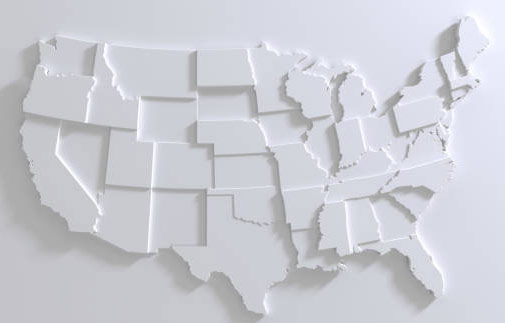
The current boundaries of the United States were last confirmed in 1959.
In 1959, with the addition of Alaska and Hawaii as the 49th and 50th states, the boundaries of the United States were completely finalized.
- Alaska joined as the 49th state on January 3, 1959.
- Hawaii joined as the 50th state on August 21, 1959.
Since then, the boundaries of the United States have remained unchanged.
The 50 states of the United States joined the federation for various historical reasons, and this process has formed an important part of America's growth and change. The states began with the original 13 and gradually expanded. While the establishment of each state is unique, it collectively reflects the development and historical events of the United States. Here is a summary of the historical order in which the 50 states joined the federation.
The Original 13 States (1776-1787)
The United States originally started with 13 colonies. These colonies were under British rule until they declared independence through the Declaration of Independence in 1776, severing ties with Britain. In 1783, the Treaty of Paris recognized America's independence, and these 13 states became the first states of the United States.
- Delaware (December 7, 1787)
- Pennsylvania (December 12, 1787)
- New Jersey (December 18, 1787)
- Georgia (January 2, 1788)
- Connecticut (January 9, 1788)
- Massachusetts (February 6, 1788)
- Maryland (April 28, 1788)
- South Carolina (May 23, 1788)
- New Hampshire (June 21, 1788)
- Vermont (July 26, 1788)
- Virginia (June 25, 1788)
- New York (July 26, 1788)
- North Carolina (November 21, 1789)
Territorial Expansion and State Admission
As the United States expanded, new states joined the federation. The territory of the United States was originally concentrated in the east, but with westward expansion, new states emerged. Significant events such as the Louisiana Purchase (1803), Texas Independence (1836), and the California Gold Rush accelerated this process.
- Tennessee (June 1, 1796)
- Ohio (March 1, 1803)
- Louisiana (April 30, 1812)
- Indiana (December 11, 1816)
- Mississippi (December 10, 1817)
- Illinois (December 3, 1818)
- Alabama (December 14, 1819)
- Maine (March 15, 1820)
- Missouri (August 10, 1821)
- Arkansas (June 15, 1836)
- Michigan (January 26, 1837)
- Florida (March 3, 1845)
- Texas (December 29, 1845)
- Iowa (December 28, 1846)
- Wisconsin (May 29, 1848)
- California (September 9, 1850)
Western Expansion and New States
In the late 19th century, as the United States expanded westward, new states continued to join the federation. Events such as the Mexican-American War (1846-1848) and the Gold Rush (1849) led to rapid development in this region.
- Minnesota (May 11, 1858)
- Oregon (February 14, 1859)
- Kansas (January 29, 1861)
- West Virginia (June 20, 1863)
- Nevada (October 31, 1864)
- Arizona (February 14, 1912)
Early 20th Century Expansion
In the early 20th century, the United States also expanded overseas, adding new states. Notably, Hawaii and Alaska were the last states to join the federation.
- New Mexico (January 6, 1912)
- Utah (January 4, 1896)
- Colorado (August 1, 1876)
- Idaho (July 3, 1890)
- Montana (November 8, 1889)
- Wyoming (July 10, 1890)
- Oklahoma (November 16, 1907)
Alaska and Hawaii
The last two states of the United States are Alaska and Hawaii, which joined the federation in 1959. Alaska became the 49th state, and Hawaii became the 50th state of the United States.
- Alaska (January 3, 1959)
- Hawaii (August 21, 1959)
The 50 states of the United States began with the 13 states that declared independence in 1776 and gradually expanded through westward expansion, the Mexican-American War, the California Gold Rush, and two world wars. With the admission of the last two states, Alaska and Hawaii, in 1959, the United States was finalized with its current 50 states.








 Weekend Movie Blog |
 Beauty, Health, Lifestyle Blog |
 coloradoman |
 Superman Cat Blog |
 Noodle Noodle |
  Tonky |
  viroma |
  cookie |
  Live and that's it |
  Alright Twain |
  eatontown blog |
  HAWAII Korean Church News |
  Amore |
  linex |
  Balancework |
  laro90 |
  MEDBIO American Doctor Blog |
  SWAT TEAM BLK |
  DREAM BIG |
  frostbite |
  330 Forever My Love |
  El Dorado |
  dralix58 |
  Gorama Round |
  Skydiving |