

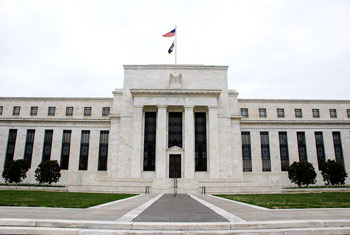
At first, you might think of it simply as the central bank of the United States, but as you delve deeper, you realize it has a significant impact not only on the U.S. economy but also on the global economy. So today, let's carefully explore what the Fed actually does and why it is so important.
The Fed is the central banking system of the United States, established in 1913. It is not just a single bank building; it consists of the Federal Reserve Board located in Washington, D.C., and 12 regional Federal Reserve Banks scattered across the country. In simple terms, it has a headquarters and branches, and they share roles to operate the core of the U.S. economy.
The most important role of the Fed is to manage monetary policy. The most common news we hear is about the "Fed raising or lowering interest rates," which is the essence of monetary policy. Lowering interest rates makes bank loans easier, increasing consumption and investment, thus reviving the economy. Conversely, raising interest rates makes borrowing more burdensome, reducing consumption and cooling an overheated economy. Additionally, when the economy is significantly contracted, the Fed can inject more money into the market through a method called quantitative easing (QE) to revive it. You may remember that during the 2008 financial crisis and the COVID-19 pandemic, the Fed injected large amounts of money to prevent the economy from completely collapsing.
The second important role is to maintain the stability of the financial system. If banks collapse, the entire economy shakes, so the Fed provides emergency loans to banks in crisis situations or supplies liquidity to prevent the financial market from freezing. It acts as a 'last resort.'
The third role is bank supervision and regulation. The Fed checks whether commercial banks in the U.S. are operating soundly and managing risks well, and it imposes regulations when necessary. If banks recklessly increase loans or make poor investments, it ultimately harms the entire national economy.
The fourth role is to operate the payment and settlement system. When we transfer money from bank accounts or when companies settle transaction payments, it is also the Fed's responsibility to manage the system to ensure that money moves smoothly. Thanks to this, the U.S. economy, which sees hundreds of billions of dollars flowing daily, operates stably.
Why is the Fed important? Simply put, the Fed is like the 'heart' of the U.S. economy. Even a slight movement in the Fed's interest rates affects everything from mortgage rates for homebuyers in the U.S. to corporate investment plans, and even the Korean stock market and exchange rates. This is why economic news always focuses intensely on "What decision will the Fed make this time?" Investors are keenly attuned to the Fed's statements for this very reason.
In summary, the Fed is not just an institution that manages money; it is a key pillar that influences the growth and stability of the U.S. economy and even the flow of the global economy. Interest rates, prices, employment, financial market stability, bank soundness, and payment systems all depend on the Fed.
Therefore, understanding the movements of the Fed while studying economics is not just a matter of knowledge; it is essential for developing the ability to read the real economy. Just by observing that investors around the world are holding their breath waiting for the results of the Fed's meetings, you can feel how significant the Fed is.







 Victory 1988 |
 El Dorado |
 lightyear |
 Moscow Kim |
 coloradoman |
 UCLA Captain |
 Experiences Living in America |
 Until the Day It Gets Better |
 Golden Knights |
  Cherokee Rose |
  Kor. Master |
  Holey Moley |
  Conflite Teacher |
  Hodong Prince Over Flex |
  Mist inn |
  citrus pop |
  Onion Ring |
  phoenixia |
  viewtop |
  loverun |
  Kim Do Sun |
  SEVEN SEVEN |
  yentra |
  Make My Day |
  Tonky |
  viroma |
  cookie |
  Live and that's it |