

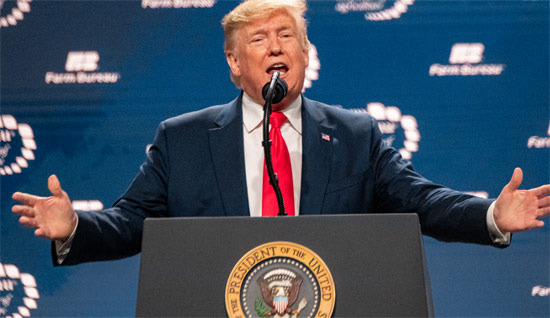
Policies seem to operate on logic, but ultimately, politics is a battle of atmosphere and momentum.
The recent ruling from the U.S. Supreme Court is a perfect example of this.
The Supreme Court ruled that the tariffs imposed by President Donald Trump under the International Emergency Economic Powers Act (IEEPA) were illegal.
Trump has strongly pushed tariffs, calling them "the most beautiful word in the world" since the last election.
Since his second inauguration, he has used this policy even more aggressively. Rather than just reducing trade deficits, he has utilized tariffs as a pressure tactic in diplomacy, security, and even negotiations with allies.
As a result, the U.S. has effectively engaged in a global trade war, forcing major allies, including South Korea, to discuss new trade agreements.
However, this ruling has undermined the legal foundation of those tariffs. It's not that the policy direction was wrong, but rather that the method of implementation was legally problematic.
This is politically significant because it shakes one of the core messages that Trump has emphasized.
He has rallied his supporters around the image that "if you push hard, America wins."
However, the fact that the Supreme Court, the highest authority in the U.S., has put the brakes on this could appear as a crack in his leadership.
Of course, many do not believe this means the end of the policy.
Given Trump's style, it is likely he will continue the tariff policy through other legal means or new methods. In fact, there is a widespread belief in Washington that "the method may change, but the direction will remain the same."
The issue is not the sustainability of the policy but the political image.
Whether he is seen as a strong president or as one who has been halted by overreaching is a completely different story.
A key variable here is public opinion. In American politics, atmosphere often plays a larger role than the success or failure of policies.
If voters perceive this incident as "the rule of law has triumphed," it becomes a burden for Trump.
Conversely, if his supporters view it as "the judiciary is politically obstructing," it could lead to a rallying effect.
Ultimately, this ruling is not the end of the policy but the beginning of a political framing battle.
Another aspect to watch is the reaction from the moderate voters.
Strong leadership can effectively rally the base, but if legal controversies continue, it may lead to fatigue among moderate voters.
With the midterm elections approaching, each of these incidents acts as a variable.
While a single event may not change the outcome, a series of small incidents can shape the overall momentum.
This ruling can be seen as one of those puzzle pieces.
From the Republican perspective, there may be a positive element of rallying the base, but the Democrats have gained a justification to attack with the frame of "a policy that disregards the law."
Ultimately, the core issue is not the policy but the atmosphere. Until now, the strength of Trump's politics has come from image rather than logic. It's the perception of a strong and assertive leader.
However, the moment the symbolic brake of the Supreme Court ruling was applied, a small crack appeared in that image.
Whether this crack will grow over time or solidify further through rallying the base remains uncertain.
It makes one reconsider the saying that politics is not about numbers but about momentum.
This ruling is not just a policy issue; it is an event that could shake the direction of public opinion.
And depending on how that public opinion flows, it is likely to act as a variable in the results of the upcoming midterm elections.





 Moscow Kim |
 coloradoman |
 Montgomery Mom |
 GOGO SING |
 Hajiwon Blog Hair Salon |
 Monte Sori |
 Until the Day It Gets Better |
 Raymond K. |
 Experiences Living in America |
 UCLA Captain |
  Finding Superfoods |
  lightyear |
  song bang |
  vexomo |
  Indiana Jones |
  meloncat |
  novapixel |
  mortrix |
  Esther 1983 |
  fortbliss |
  My Two Way |
  toastyfox |
  FLORIDA Acus |
  tracker |
  TONTON COFFEE |
  sunrise |
  ultron78 |
  uplifted |
  Folding Instructions |