

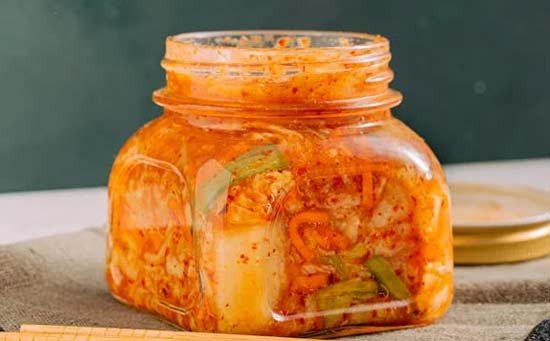
Kimchi is a living fermented food.
Therefore, how you manage temperature, time, and salinity completely determines the flavor.
Understand How Fermentation Works
-
Lactic acid bacteria consume the sugars in cabbage and produce lactic acid, creating a sour taste.
-
If the temperature is high, lactic acid bacteria multiply rapidly, causing it to sour quickly; if low, it ferments slowly, allowing for longer storage.
-
When the pH drops below 4.2, most harmful bacteria cannot survive, making it hygienically safe.
Fermentation Temperature: 4-6°C, Storage Temperature: Around 0-2°C
-
Initially, fermenting at around 5°C for a day or two will evenly distribute the flavor throughout the cabbage.
-
For kimchi that you want to eat quickly, keeping it at 6-8°C for half a day to a day will enhance the sourness.
-
When the flavor is just right, quickly lower the temperature to 0-2°C to almost stop fermentation, preserving the crunchiness.
Adjust Slightly Based on Kimchi Type
-
Napa cabbage kimchi and cubed radish kimchi: Use the basic temperatures mentioned above.
-
Young radish kimchi: For a refreshing broth, ferment quickly at around 6°C.
-
Dongchimi and water kimchi: For a clear broth flavor, ferment slowly at low temperatures of 2-4°C.
-
Baekkimchi: If you want to delay sourness and enhance sweetness, long-term fermentation at 1-3°C is ideal.
Small Tips for Using a Kimchi Refrigerator
-
Store in a dedicated container with as much air removed as possible to prevent surface drying and mold.
-
If you keep opening and closing one container, the temperature fluctuates, so it's convenient to portion out about a week's worth into another airtight container.
-
After making kimchi, leave it at room temperature for about 12-24 hours before moving it to the refrigerator; this helps the lactic acid bacteria start well, enhancing the flavor.
-
If your refrigerator has a slushy mode (around -1°C), use it to prevent kimchi from souring too quickly.
If You See This While Storing, Here's How to Respond
-
If there is overflow or excessive bubbles → The container is too full or the temperature is too high. Remove some and lower the temperature by 1-2°C.
-
If a white mold film appears on the surface → This means the exposed area has dried out. Remove the top layer and add a little kimchi broth to restore cleanliness.
-
If it has become too sour → Adding a little sugar or broth while cooking can neutralize the sourness, making it palatable.
Remember that small temperature differences can significantly change the flavor when using a kimchi refrigerator!





 Yellow Snowman |
 Moscow Kim |
 Seattle - Emerald City |
 self-evaluation |
 Sandiego Auntie |
 Weekend Movie Blog |
 Beauty, Health, Lifestyle Blog |
 coloradoman |
 Superman Cat Blog |
 novapixel |
  Tonky |
  viroma |
  cookie |
  Live and that's it |
  Alright Twain |
  eatontown blog |
  HAWAII Korean Church News |
  Amore |
  linex |
  Balancework |
  laro90 |
  MEDBIO American Doctor Blog |
  SWAT TEAM BLK |
  DREAM BIG |
  frostbite |
  330 Forever My Love |
  El Dorado |
  dralix58 |
  Gorama Round |
  Skydiving |