
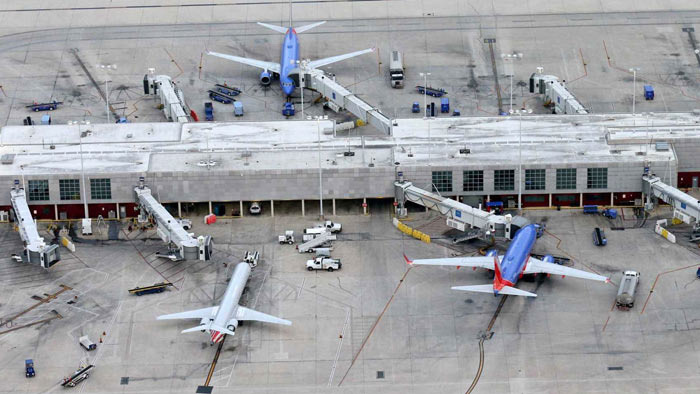
Whenever I look at San Antonio International Airport, I always feel that it is quite well operated.
There are only two runways, but each is 8,500 feet long, or about 2.6 kilometers, which is sufficient for most medium-sized aircraft to take off and land. However, large aircraft like the Boeing 747 are a different story. The 747 typically requires a runway of over 10,000 feet, which is more than 3 kilometers, for takeoff.
Given the length of San Antonio Airport's runways, it is somewhat short, making it challenging for a fully loaded 747, but it is possible under conditions such as reducing fuel or carrying only cargo. In fact, cargo airlines like Atlas Air have successfully landed here, and on such days, aviation fans with cameras gather around the airport.
However, just because a 747 lands does not mean that passenger operations are active. Typically, it comes in for maintenance, repairs, or special cargo purposes. While the runway width is sufficient, the terminal structure is centered around medium-sized aircraft, making it difficult to park at regular gates. Ultimately, San Antonio Airport can accommodate a 747, but only in exceptional circumstances.
Now, let's talk about future changes. Currently, the construction of 'Terminal C' is underway at the airport. It will cover approximately 830,000 square feet, complementing the existing A and B terminals, with 17 additional gates. The completion goal is set for 2028, and all international functions, check-in facilities, customs, and security checks are being newly designed. Interestingly, the new terminal plans include several 'wide-body aircraft compatible gates,' meaning that designs are considered for aircraft like the Boeing 787 or 777.
However, simply expanding the terminal is not enough for aircraft to land. The runway length, taxiway width, taxi routes, and ground support vehicle pathways must all align. Currently, based on the runway length at San Antonio Airport, the 787 can land.
However, there is insufficient room for a fully loaded long-haul flight. For example, the 787-9 model is said to require about 13,000 feet, or approximately 4 kilometers of runway, while San Antonio Airport is 5,000 feet shorter than that. Therefore, it is more realistic to operate in a medium-haul or domestic capacity by reducing fuel rather than long-haul flights.
In summary, once Terminal C is completed, San Antonio Airport will be ready to welcome much larger aircraft than it currently does. Gates for aircraft like the 787 will be secured, and international functions will be significantly enhanced.
However, unless runway expansion accompanies this, launching long-haul flights at full capacity will still be a challenge. Nevertheless, given the city's growth rate, I believe that one day, 787s will regularly take off and land over San Antonio.
Below is a video of the very rare scene of a 747 landing at San Antonio Airport. It seems that it can land because it is a cargo plane that does not need to drop off passengers.








 Helpful Life Stories |
 American Man in a Mask |
 USA Pharmacy Pharmacist |
 Texas Migration Story |
 Texas Migration Story |
  Tonky |
  viroma |
  cookie |
  Live and that's it |
  Alright Twain |
  eatontown blog |
  HAWAII Korean Church News |
  Amore |
  linex |
  Balancework |
  laro90 |
  MEDBIO American Doctor Blog |
  SWAT TEAM BLK |
  DREAM BIG |
  frostbite |
  330 Forever My Love |
  El Dorado |
  dralix58 |
  Gorama Round |
  Skydiving |