

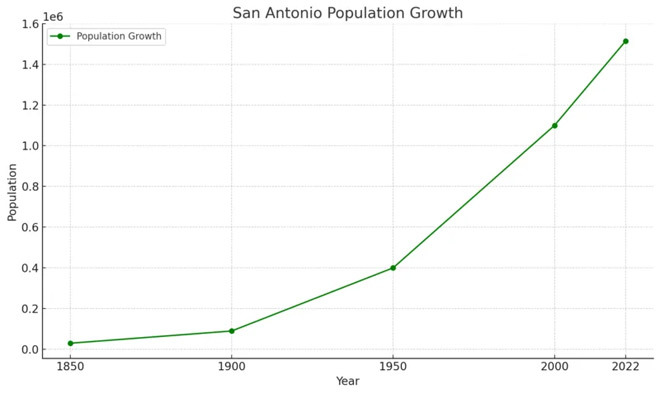
Most people say it's absurd to claim that San Antonio is a larger city than Dallas.
However, in reality, San Antonio is the 7th most populous city in the U.S., while Dallas ranks 9th.
Although Dallas is much larger in terms of metropolitan area, its city boundaries are narrowly defined, resulting in a smaller city population, whereas San Antonio has a much larger area that includes surrounding suburban regions. Therefore, in terms of demographics, San Antonio ranks above Dallas.
When looking at the city of San Antonio itself, it is one of the fastest-growing cities in the U.S.
There are several practical reasons behind San Antonio's growth. First, housing costs are among the most affordable in Texas's major cities.
While Austin and Dallas are suffering from skyrocketing home prices and rents, San Antonio has maintained a stable real estate market.
This has attracted young families and middle-class migrants. Additionally, the city has a well-developed military presence, healthcare industry, and tourism sector, making it resilient to economic fluctuations.
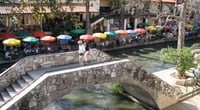
Tourist attractions like the River Walk, the Alamo, and the Mission Trail draw visitors year-round, and large military bases provide steady employment.
However, this growth is not always positive. The rapid population increase is straining the city's infrastructure. Traffic congestion is worsening, and housing developments expanding into suburban areas are outpacing transportation networks.
Public transportation in San Antonio remains weak, making it difficult to get around without a car. While Uber is available, it is not easily accessible in remote areas.
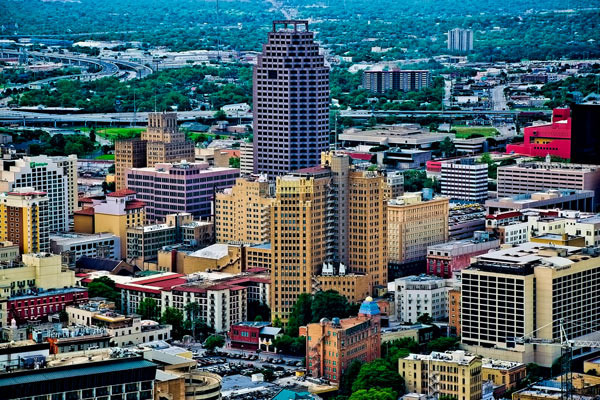
Moreover, the downtown area of San Antonio is designed around tourist attractions near the River Walk, causing essential infrastructure for daily life to be dispersed into the suburbs. As a result, longer commutes are leading to increased traffic accidents and pollution issues.
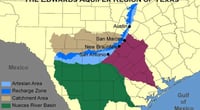
Another issue is water. The primary water source for San Antonio is the Edwards Aquifer, which is already nearing its limits. Climate change and drought could lead to water supply problems, and the risk increases with the growing population.
In fact, the city government periodically enforces water usage regulations, and the installation of water-saving devices is mandatory for new housing developments. If urban expansion continues, water scarcity could become a significant risk in the future.
The character of the city is also changing noticeably. San Antonio was originally a relaxed, family-oriented city, but in recent years, an influx of outsiders has led to increased traffic, rising crime rates, and higher rents, experiencing the 'side effects of urbanization.'
Ultimately, while population growth drives the city's expansion and prosperity, problems will inevitably arise if management does not keep pace. San Antonio is already grappling with issues related to traffic, housing, water, public safety, and the environment. To maintain the current growth rate, sustainable urban planning is necessary rather than simply expanding land.
The fact that it has a larger population than Dallas can be a point of pride, but it also signifies many challenges. How San Antonio addresses these issues will determine whether it becomes a successfully developed city or an overcrowded one in the future.

 Helpful Life Stories |
 American Man in a Mask |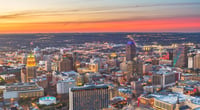
 Texas Migration Story |
 USA Pharmacy Pharmacist |
 Texas Migration Story |
  yentra |
  Make My Day |
  Victory 1988 |
  Tonky |
  viroma |
  cookie |
  Live and that's it |
  Alright Twain |
  eatontown blog |
  HAWAII Korean Church News |
  Amore |
  linex |
  Balancework |
  laro90 |
  MEDBIO American Doctor Blog |
  SWAT TEAM BLK |
  DREAM BIG |
  frostbite |
  330 Forever My Love |
  El Dorado |