
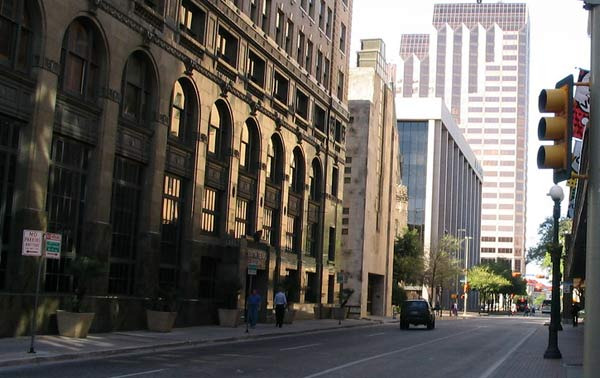
If you've walked through Downtown San Antonio on a weekend, you can relate.
The area around the River Walk is bustling with tourists and lively music, but just a short distance away, it becomes eerily quiet, almost like a different city. On weekdays, you can see many office workers and business travelers, but on weekends, foot traffic drops significantly, and it often seems like there are more closed shops.
When you first experience this atmosphere, you might wonder, "Why does it feel so empty?"
Much of the central area of Downtown San Antonio is designed as a 'business hub.' With city hall, courthouses, financial institutions, government offices, and office buildings clustered together, the population swells during the week with people commuting to work, but on weekends, they all leave. In neighborhoods that are primarily office worker-based, demand naturally decreases on days when businesses are closed.
Another factor is the lack of residential population. While there are many hotels, the actual density of residents is lower than expected. Tourists tend to concentrate around the River Walk and stay there, while housing for residents is spread out in the outskirts of downtown, leading to a naturally empty feeling in the central area on weekends.
Unlike cities like New York or Chicago, where residential and commercial areas are strongly mixed, the tourist and government areas in San Antonio are clearly separated, resulting in a skewed 'flow of people.' Therefore, shopping malls, cafes, and restaurants thrive only in specific areas, and if you move just a little away, it's common for them to reduce their hours or even close entirely.
Safety and atmosphere issues also play a role. The River Walk, which attracts tourists, and the historic buildings on Main Street are well-maintained and pleasant for walking, but once you enter blocks with fewer people, it can feel deserted, and the lack of activity can make you quicken your pace.
While there is a perception that it is safe during the day, at night or on holidays, the reduced number of people makes the atmosphere feel even more desolate. Ultimately, for a commercial area to thrive, people need to gather, but since the flow of people is concentrated in specific locations, it is difficult for the entire downtown to feel alive.
However, this quietness is not necessarily a disadvantage. Unlike the busy city center on weekdays, weekends offer the advantage of leisurely exploring historic buildings and walking along wide sidewalks. You can enjoy sipping coffee in the sun at the plaza in front of city hall, listening to church bells, or taking aesthetic photos of quiet streets for Instagram. Not everyone prefers crowded tourist spots.
Recently, there have been reports of new restaurants, bars, and art galleries slowly emerging in the old town, indicating a 'small change' where people are starting to gather again. If large-scale developments begin, more residential complexes may come in, and an increase in weekend cultural events could significantly change the current atmosphere.
The reason some areas of Downtown San Antonio feel empty on holidays is due to its business-centric structure, low resident population, tourism concentrated around the River Walk, and uneven flow of safety and commerce in the city. However, I believe there is charm in this tranquility and ample potential for change in the future.




 Helpful Life Stories |
 American Man in a Mask |
 Hajiwon Blog Hair Salon |
 Make My Day |
  TEXAS Fishing Boat |
  laro90 |
  MEDBIO American Doctor Blog |
  SWAT TEAM BLK |
  DREAM BIG |
  frostbite |
  330 Forever My Love |
  El Dorado |
  dralix58 |
  Gorama Round |
  Skydiving |
  dreamport |
  Yellow Snowman |
  Toaster Pizza Magic Show |
  velvetnom |
  Anytime Journey |
  Mrs. Duluth |
  jaxter |
  Atlanta Mama |
  Baguette Blog |
  Tan Sol |