
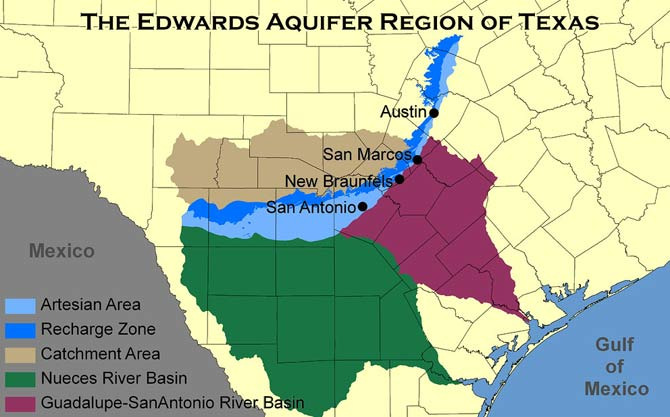
San Antonio is home to a massive aquifer, the source of the water we use every day.
The aquifer is a vast underground water system where water is stored beneath the ground. Rain or river water seeps into the ground and collects in rock crevices, gravel layers, and limestone areas, functioning like an underground reservoir. The Edwards Aquifer, which is primarily used in San Antonio, has the same structure, where rainwater is quickly absorbed and stored through sinkholes and caves.
This water is drawn up through wells for drinking, agriculture, and industry. Although it is not visible, it is essential for urban survival, and as development increases and land is covered with concrete, replenishment may become difficult, making protection important.
Texas is not a region with consistent rainfall, so the most famous water source is the Edwards Aquifer. Water is stored in the limestone layers, and when it rains, it seeps through the ground's crevices, caves, and sinkholes. Therefore, in years with heavy rainfall, the water level rises, and during droughts, it drops quickly. Most of the drinking and industrial water used by millions of San Antonio residents comes from this source.
This aquifer is also quite deep. Depending on the area, one may have to go down hundreds to thousands of feet to reach the water layer. Because of this vast and deep water reservoir, San Antonio can withstand its desert climate and hot summers. Without this water, the city would not be able to exist at its current scale.
However, with rapid development, new concerns are arising. As roads, buildings, and apartments increase, rainwater cannot seep into the ground and simply flows away. If the recharge zones are covered with concrete, even when it rains, the water will not be replenished. Many places that used to have natural springs have now dried up. The water is still below, but the water level has dropped, preventing it from rising to the surface.
Therefore, San Antonio is trying not to rely solely on one aquifer. It also uses auxiliary sources like the Trinity Aquifer and Carrizo Aquifer, and employs ASR (Aquifer Storage and Recovery) methods to store water for use during droughts. This method allows for ample storage when water conditions are good, serving as a precaution against crises. Diversifying water sources is not just a choice but a survival strategy. With a growing population, factories, data centers, and the need for agricultural water, one cannot rely solely on summer rains.
The aquifers in this region are extremely valuable assets. What appears to be ordinary hills and grasslands may actually be crucial land for groundwater replenishment. While it is not about completely halting development, efforts must be made to keep some areas as parks, maintain permeable green spaces, and protect waterways and recharge zones; otherwise, there may come a time when turning on the tap yields no water.
Ultimately, the future of San Antonio depends on how well we protect this aquifer. This water source is familiar to us but is by no means infinite. It is easy to forget because it is not visible, but it is becoming increasingly precious as the city grows. For San Antonio to continue being a livable city, we must remember and manage this invisible river flowing beneath us.







 Helpful Life Stories |
 American Man in a Mask |
 USA Pharmacy Pharmacist |
 Texas Migration Story |
 Texas Migration Story |
  Tonky |
  viroma |
  cookie |
  Live and that's it |
  Alright Twain |
  eatontown blog |
  HAWAII Korean Church News |
  Amore |
  linex |
  Balancework |
  laro90 |
  MEDBIO American Doctor Blog |
  SWAT TEAM BLK |
  DREAM BIG |
  frostbite |
  330 Forever My Love |
  El Dorado |
  dralix58 |
  Gorama Round |
  Skydiving |