

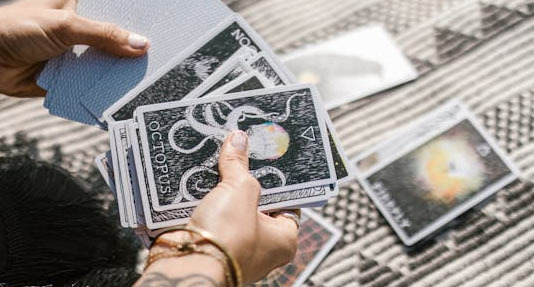
When you hear about tarot cards or hanafuda, it can feel like a mysterious and difficult world. However, there's no need to think too grandly about it. In fact, many people approach these card readings as a light hobby that allows them to reflect on their situations by looking at the images or symbols, rather than as a magical way to predict the future. So feel free to read on without any pressure.
First, let's talk about tarot cards. Tarot cards consist of a total of 78 illustrated cards. Each card features symbolic images of people, objects, or landscapes. These images symbolically represent emotions or situations commonly experienced in life. The idea is to draw a card and reflect on your current situation while interpreting the image yourself. Therefore, many people see tarot not as a way to predict the future, but as a tool for organizing their thoughts.
The origins of tarot cards are not as old as you might think. It is believed to have started in the 15th century in Northern Italy, where nobles enjoyed card games. Initially, they were simple game cards, but in the 18th century, astrologers in France began interpreting these cards as divination tools, leading to the tarot culture we know today. In the 20th century, the Rider-Waite-Smith deck emerged, systematically incorporating symbols into the card illustrations, and this deck became the basis for the widespread popularity of tarot around the world. Nowadays, many artists are creating newly designed tarot cards, making it a popular hobby for collectors.
A complete set of tarot cards is generally divided into two categories: the Major Arcana, which consists of 22 cards, and the Minor Arcana, which has 56 cards. The Major Arcana symbolizes significant life events or important turning points, representing meanings such as new beginnings, change, and choices. In contrast, the Minor Arcana expresses everyday events or emotions. The Minor Arcana is divided into four suits: Wands, Cups, Swords, and Pentacles, each containing 14 cards.
If you're new to tarot, there's no need to start too complicated. The easiest method is the one-card draw. Simply draw one card and reflect on your feelings or advice for the day. Once you become a bit more familiar, the three-card draw is also commonly used, allowing you to see the flow of past, present, and future or interpret it in structures like problem, cause, and advice.
Reading the cards is also simpler than you might think. It's best to start by formulating a specific question. Instead of vaguely asking, "Will things go well in the future?" it's better to ask something more realistic, like, "What should I focus on in my next interview?" After shuffling the cards, draw one or several and look at the parts that catch your eye first. Elements like colors, facial expressions of figures, and objects can provide hints. Then, you can refer to a book or app for interpretations and connect them to your situation.
Hanafuda is often compared to tarot. Both are tools for fortune-telling, but they have quite different backgrounds. Tarot cards developed from Western culture, while hanafuda originated from the Japanese Hanafuda cards that evolved in Korea. In Korea, hanafuda is mainly used for games during holidays like the Lunar New Year, but some also use it for fortune-telling.
The composition of the cards also differs. Tarot consists of 78 cards with a defined arrangement, while hanafuda typically consists of 48 cards. In hanafuda fortune-telling, interpretations are often made through card combinations. For example, if certain cards from a specific month appear together, it may indicate connections or financial luck.
The methods of symbolic interpretation also vary slightly. Tarot involves creating a narrative through the symbols in the card images. Elements like colors, numbers, and the posture of figures create meaning. Therefore, it is also used as a tool for psychological counseling or self-reflection. In contrast, hanafuda fortune-telling often interprets the combinations of cards themselves, making it relatively straightforward to interpret the results based on which cards appeared together.
There are also differences in the approach. Tarot has formed a hobby culture worldwide, making it easily accessible through cafes, apps, and YouTube. On the other hand, hanafuda fortune-telling is often more closely associated with fortune-telling houses or shamanistic culture in Korea, making it a more localized cultural practice.
Ultimately, there's no need to think of either tarot or hanafuda as overly mysterious. They can be enjoyed lightly as tools for reflecting on your current situation by looking at the card images or symbols.






 Khan Film Blog Production |
 dermoon |
 hoosierdaddy |
 sun walker |
 Let's Be Like a Salt-like City Person |
 Weekend Movie Blog |
 Beauty, Health, Lifestyle Blog |
 coloradoman |
 Superman Cat Blog |
 Awesome Blog |
  Finding Superfoods |
  lightyear |
  song bang |
  vexomo |
  Indiana Jones |
  meloncat |
  novapixel |
  mortrix |
  Esther 1983 |
  fortbliss |
  Moscow Kim |
  My Two Way |
  toastyfox |
  FLORIDA Acus |
  tracker |
  TONTON COFFEE |
  sunrise |
  ultron78 |
  uplifted |
  Folding Instructions |