

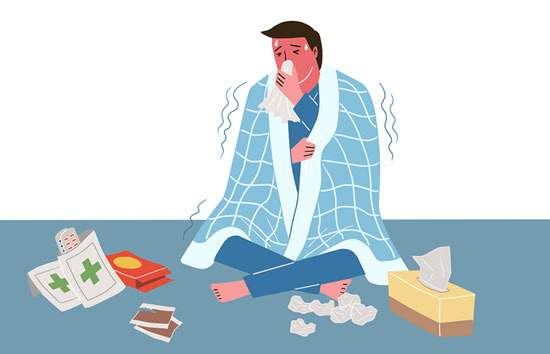
This month, I have been experiencing some unusual symptoms. It doesn't seem like a serious illness, but I haven't felt quite right.
I have a slight feeling of nasal congestion and it seems like I might be coming down with a cold, and I also felt warm as if I had a mild fever.
However, it wasn't a full-blown fever, just an ambiguous state.
Now that I'm in my 50s, even small changes in my body make me a bit anxious.
In the past, I would have just thought, "Looks like I'm coming down with a cold," but these days, I pay a bit more attention to my health.
Upon reflection, these symptoms seem to commonly appear during the early stages of a cold.
Nasal congestion and suddenly a runny nose. My body feels a bit sluggish, and I have a sensation of mild fever.
When the body reacts to a virus and the temperature rises slightly, it can make you feel warmer than usual.
At first, I thought it was just fatigue. But I noticed a bit of nasal congestion and a scratchy throat.
In such cases, it is often a viral upper respiratory infection, commonly referred to as a mild cold.
Typically, after 2-3 days, symptoms like a runny nose or cough become more pronounced.
Another possibility to consider is the early stages of the flu or COVID-19. These days, even minor changes in my body lead me to think about these possibilities first.
However, with the flu, there is usually a significant fever and strong body aches. What I experienced wasn't that severe.
Looking back, I realized I had been a bit sleep-deprived and busy with work lately. As a result, I think I was accumulating fatigue and my immune system was weakened. In such a state, the body can react sensitively to even mild viruses.
So, I focused on resting rather than taking any special medication. I drank plenty of water, kept warm, and went to bed early.
When feeling cold symptoms, Tylenol can be somewhat helpful. The main ingredient in Tylenol, acetaminophen, helps lower fever and relieve pain from body aches or headaches. So, in the early stages of a cold, if you have a mild fever or feel chills and have a headache, it can help alleviate those symptoms.
However, Tylenol is not a medication that treats the cold virus itself. In other words, it is more of a medication that reduces uncomfortable symptoms like fever and pain rather than curing the cold. So, when you feel a bit warm or have a mild fever, or if you feel achy, taking it once can often relieve the symptoms.
Still, it is advisable to be cautious about certain symptoms. If the fever rises above 100.4°F (38°C), or if coughing or phlegm worsens, or if body aches or headaches intensify, it may not just be a simple cold. If you feel short of breath or have difficulty breathing, it is best to go to the hospital immediately.
Most mild colds tend to resolve within 2-3 days. They either improve or the runny nose or cough becomes more pronounced.
Especially in your 50s, there are rare cases where a cold can lead to bronchitis or pneumonia. So, if the fever persists for 3-4 days or if your condition worsens, it is safer not to just endure it but to go to the hospital for a check-up.
This time, since I felt a bit off, I realized again that I am now more attentive to the signals my body sends, which I used to brush off when I was younger.
And indeed, when something feels off, I am reminded that the best medicine is to rest.





 Diana Blues |
 Dragon Lee |
 Churros Train Conductor |
 Tora Tora |
 neroyo |
 Weekend Movie Blog |
 Victory 1988 |
 Superman Cat Blog |
 Beauty, Health, Lifestyle Blog |
 coloradoman |
  urban legend |
  coolriver |
  Good Neighborhood, Wealthy District Information |
  Ro Ro Car |
  Amber H |
  new sugar |
  Palm 1000 |
  loran |
  donutfield |
  Tennis City |
  sunny7 |
  Questions about firearms while living in America |
  Shoot Me |
  mochifox |
  zucchini |
  Anna Life |
  Exciting FM Radio |
  pet dog |
  toodin |
  rosed |