
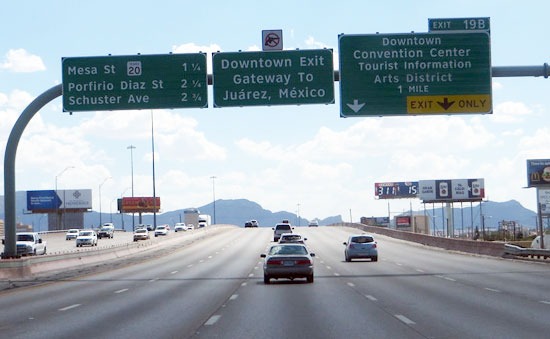
When talking about El Paso, Texas, it's hard to discuss the area's traffic situation without mentioning the I-10 freeway.
El Paso is a city located on the U.S.-Mexico border in the southwestern part of Texas, and geographically and industrially, it breathes and moves along I-10. Unlike other major cities that are intertwined with multiple highways, I-10 essentially serves as the backbone of El Paso.
I-10 is a major artery of the southern United States, starting in Santa Monica, California, and stretching through Arizona, New Mexico, and southern Texas to Jacksonville, Florida. El Paso is a gateway where trade between the West, the Midwest, and the Mexican border converges along this long east-west freeway.
The reason most of El Paso's logistics warehouses, industrial complexes, border trade facilities, shopping malls, and residential areas are lined up along I-10 is due to this very fact. For the people of El Paso, I-10 is not just a road; it is a lifeline connecting their workplaces, homes, and the rhythm of the city.
Interestingly, there are very few other freeways in El Paso that are as influential as I-10. It is completely different from the complex highway networks in Houston, such as I-10, I-45, and I-69, or the structures in Dallas, like I-20, I-30, I-35, and I-635. Besides I-10, which runs north-south, there are auxiliary roads like US-54, Loop 375, and Loop 601, but these serve more of a supporting role. Over 70-80 percent of the city's traffic relies on I-10. Most commuting, freight, and military supplies are carried along this single road.
This structure has also shaped the character of El Paso. The city has grown like a long ribbon centered around I-10, connecting the downtown area with the eastern and western regions via this freeway. When I-10 gets congested during rush hours, it feels as if the entire city of El Paso has come to a standstill. Conversely, whenever construction on I-10 is completed or lanes are expanded, the economy of El Paso immediately breathes easier.
Real estate and industry also follow the flow of I-10. Logistics companies, warehouses, manufacturing plants, shopping centers, and new housing developments almost invariably consider accessibility to I-10 first. In El Paso, the question "How many minutes away from I-10?" serves as a benchmark for property values and commercial viability. Unlike other major cities where multiple highways divide the urban area, El Paso has a very unique structure where all living zones align along I-10.
Thus, the relationship between El Paso and I-10 is not just about transportation infrastructure; it defines the very character of the city. All identities of El Paso as a border trade city, military logistics hub, and southwestern crossroads are created on I-10. To understand El Paso, there's no need to unfold a map. A drive along I-10 will naturally reveal why this city has become a community of fate with this road.








 candytip |
 Gold Bar |
 Pirate Ship Popcorn Maker |
 Montgomery Mom |
 Anjollinya Blog |
 fortbliss |
 Tomex Train Uncle |
 hexon |

 Spicy Immigration Life |
  Anytime Journey |
  Mrs. Duluth |
  jaxter |
  Atlanta Mama |
  Baguette Blog |
  US Embassy |
  Korean Mom |
  My NYC |
  moo moo |
  Mr Oh |
  forevergee |
  festival |
  manchester |
  constant |
  Leapfrog Move |
  vibranto |
  Tora Tora |
  yellowbutter |
  Dolly |
  NYC saladbar |