

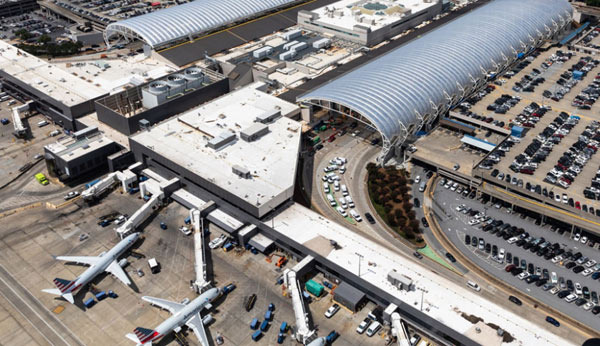
Hartsfield-Jackson Atlanta International Airport (ATL) brings a smile to first-time visitors with its sheer size.
How can an airport be this big?
With endless walkways, an air train that resembles a subway, terminals packed with people, and planes taking off all day long, this airport feels like a massive station where people from all over the world gather and disperse. It is enormous, and it has held the title of the busiest airport in the world since the late 1990s. As of 2024, it was reported that approximately 100 million passengers used the airport.
All day long, takeoffs and landings happen without a break, and countless passengers flock here to connect to other states and international destinations. With over 192 boarding gates, just looking at the numbers is overwhelming, but walking through the endless corridors and massive transportation systems is truly impressive.
Whether traveling in the southeastern United States, connecting to Florida, or heading to South America and the Caribbean, most people pass through here at least once. Interestingly, some travelers leave without even knowing where Atlanta is, having only seen the airport. This shows just how significant a hub this airport is for connections.
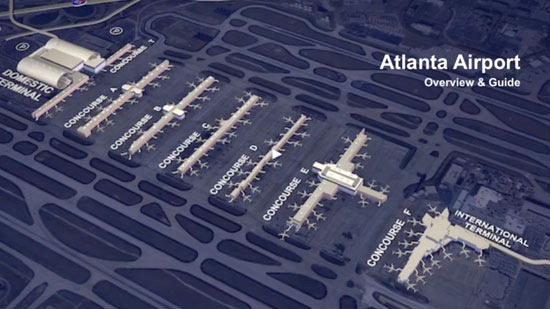
The terminals are divided from A to F, and the underground transportation system is so fast and efficient that if you time it right, you can transfer comfortably. So, despite the busyness, it strangely feels less stressful.
Another unique aspect is the overwhelming number of restaurants and shops. It's not just the usual McDonald's and Starbucks; there are also southern-style chicken, barbecue, and peanut-based dishes, making it easy to choose a meal for your first bite or during a layover.
The terminal layout is also designed efficiently. There are two terminals for domestic and international flights, followed by seven massive concourses labeled T, A, B, C, D, E, and F. The transfer between terminals is handled by the underground automated train called the 'Plane Train,' which is fast and well-connected, making transfers easy.
Thanks to this connection system, despite its enormous size, the airport is rated as having relatively low transfer stress. In fact, it is said that about 80% of the U.S. population lives within a two-hour flight from this airport, so the claim that ATL is a prime location for domestic transfers is not an exaggeration.
Moreover, the staff is friendly and quick, so even though it's bustling, the service feels smooth and efficient. The fame of Hartsfield Airport is not just due to its size. This airport is the headquarters of Delta Airlines and a key hub for southeastern air travel.
As a result, Delta users come and go almost like it's their home, and Delta lounges, facilities, and staff are seamlessly integrated throughout the airport. This allows for quick connections, and late transfers are handled relatively flexibly for Delta passengers.
Routes to South America and Europe are also densely connected through Delta, making the airport a prime example of how an airport can sustain a city's economy, even if it's not a hugely famous tourist destination. Interestingly, while one might think the airport would be chaotic due to its size, it is surprisingly orderly, and once you understand the routes, it's simpler than expected.
Ultimately, ATL is not just a busy airport; it serves as a central hub that continuously moves the economy and travel patterns of the southeastern United States. Just passing through gives you a glimpse of the city's character, and even a brief stay makes you feel that 'all roads diverge and connect here.' Thus, for many travelers, ATL remains a memorable airport, even if it's not their destination.







 candytip |
 Gold Bar |
 Pirate Ship Popcorn Maker |
 Montgomery Mom |
 Anjollinya Blog |
 Cherokee Rose |
 Dingho and USA News |
 moonshine 7 |
 Let's Be Like a Salt-like City Person |
 Gimmi207 Blog |
  manchester |
  constant |
  Leapfrog Move |
  vibranto |
  Tora Tora |
  yellowbutter |
  Dolly |
  US Embassy |
  NYC saladbar |
  Finding Superfoods |
  lightyear |
  song bang |
  vexomo |
  Indiana Jones |
  meloncat |
  novapixel |
  mortrix |
  Esther 1983 |
  fortbliss |
  Moscow Kim |