

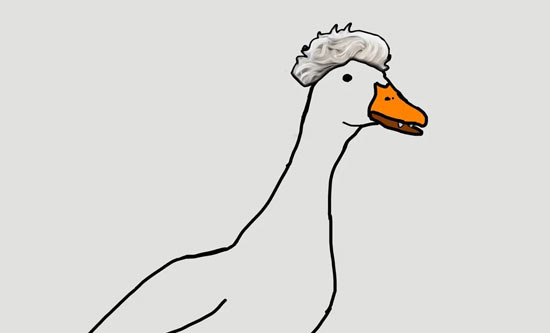
Living in Maine at the northeastern tip of the US, you learn a lot of interesting things. Whether it's about people or the weather, sometimes they can just be stubborn.
Just like the sky insisting, "This is spring," even when it's snowing heavily, the locals often act unexpectedly.
For example, if a Korean person saw their younger sibling trying to go out in shorts on a snowy day, they would say, "Hey, you chicken head, can't you see it's snowing outside?" But in the US, they would say, "You silly goose. Go put some pants on before you freeze."
However, the difference here is that calling someone stupid in Korea makes them feel genuinely foolish, so terms like "chicken head" or "goldfish" are used only among close friends. Similarly, in the US, when they want to insult someone for being truly foolish, they use stronger words like 'stupid' or 'idiot,' not 'silly goose.'
But why a goose in the US?
This is a metaphor that reflects American sensibilities. From a distance, geese look so peaceful, right?
But as you get closer, they charge at you for no reason, peck at the ground, and glare at you with a look that says, "This is my territory!" They look elegant from afar, but up close, they seem completely antisocial.
So, saying someone is "like a goose" in the US means they are not just foolish, but also someone who crosses boundaries inappropriately and lacks situational awareness while being full of energy.
So why are we sometimes designed to act like these 'geese'?
Philosophically, it seems that humans are not just machines that choose the right answers, but 'beings that test possibilities.'
Living strictly by the rules may be efficient, but it doesn't open up new paths.
The seemingly pointless curiosity or antics that others might think, "Why are they doing that?" accumulate and eventually change civilization.
When the brain occasionally presses the silly button of "What if I try this?" it's like an engine running to keep the world from stopping.
Another aspect is that this is a kind of 'social signal.'
It shows through actions that I can move differently from others.
Wearing strange clothes or making unexpected choices is like a symbol of announcing my own existence.
If this strategy succeeds, it becomes 'personality,' and if it fails, it becomes 'goose.'
Ultimately, geese aren't acting foolishly; they are just overly charged with the instinct to protect their territory and family.
We humans also want to be recognized, feel a sense of control, or sometimes just seek stimulation when the day feels too boring. Our silliness is not a flaw but a sign that we are alive.
After enduring Augusta's long winter, I feel that both people and nature sometimes need to be a little silly to maintain balance.
Even when a snowstorm rages, the next day the sun shines brightly, and someone might stop shoveling snow to pick up a shovel and share a laugh.
We also sometimes make goose-like decisions that stray from our plans, but in fact, that often brings unexpected fun to life, right?
Just one thing to remember: for our silliness to become a wonderful personality, we must at least avoid putting others down.
As long as we don't charge in like a goose, aren't we all just fine as we are?
 Eagle5thYr







 eatontown blog |
 Toaster Pizza Magic Show |
 US Embassy |
 fortbliss |
 Folding Instructions |
 milkyotter |
 cookiefox |
 New England |
 Tonky |
  viroma |
  cookie |
  Live and that's it |
  Alright Twain |
  HAWAII Korean Church News |
  Amore |
  linex |
  Balancework |
  laro90 |
  MEDBIO American Doctor Blog |
  SWAT TEAM BLK |
  DREAM BIG |
  frostbite |
  330 Forever My Love |
  El Dorado |
  dralix58 |
  Gorama Round |
  Skydiving |