

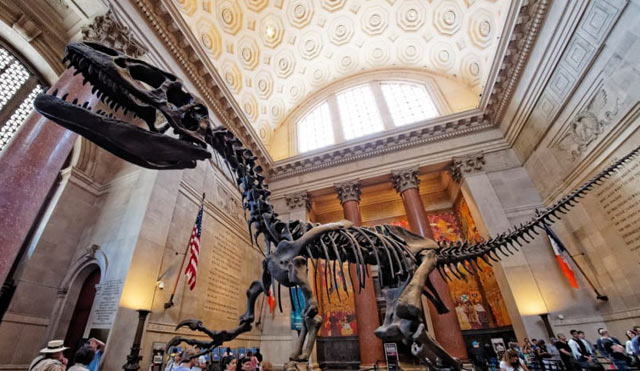
In Manhattan, New York, there is the 'American Museum of Natural History'.
Located on the west side of Central Park at 81st Street, this museum became more famous due to the movie
"This is the Tyrannosaurus Rex (T-Rex)!" I heard excited voices of children all around, and at that moment, I felt like I was transported back to my childhood. The highlight of this place is undoubtedly the dinosaur exhibit. When you enter the 'Fossil Halls', life-sized dinosaur bones stand in a row, with the Tyrannosaurus, Triceratops, and Brontosaurus all restored to their actual size.
Entering this space feels like time has stopped. It feels as if the fact that dinosaurs once ruled this Earth is being proven right before your eyes. Next, I was impressed by the 'Hall of Ocean Life'. The massive model of a whale hanging from the ceiling symbolizes this exhibit, and walking underneath it makes you feel like you are actually swimming in the ocean.
Marine life specimens and models are intricately displayed, and thanks to the currents and lighting effects, the realism is incredible. Both children and adults are busy taking pictures under the whale. And a must-visit place is the 'Rose Center for Earth and Space', which is the planetarium. This place covers everything about Earth and the universe.
When you enter the massive spherical 'Hayden Planetarium', a video unfolds across the entire dome that looks like stars are pouring down, and it was amazing to feel such a serene universe in the middle of New York. From the birth of stars to the formation of black holes, and the future of the universe, it shows an overwhelming scale in just about 30 minutes. Not only children but also adults were holding their breath, staring at the screen.
This space seems to gather all the knowledge of the world, from anthropology, biology, astronomy, to geology. I realized once again that the museum is not just a place to display exhibits, but a 'space where learning and awe coexist'.
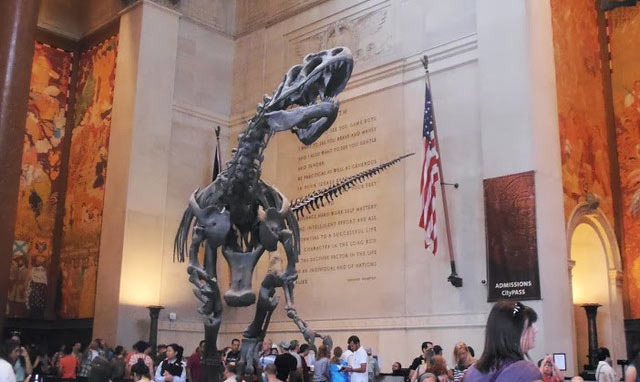
First of all, the biggest commonality is the scale that deals with the entirety of natural history. Both museums are organized to allow visitors to see all life and environments at a glance, including animals, plants, minerals, geology, human evolution, dinosaurs, marine life, and the universe. When you enter the natural history museum in New York, the dinosaur skeletons stand overwhelmingly tall, and in the lobby of the Natural History Museum in London, the once-symbolic giant Diplodocus (Dippy) dinosaur bones or the current whale model greet visitors.
Another commonality is the combination of educational purpose and public accessibility. Both museums do not just end with displaying exhibits but draw scientific curiosity into everyday life. There are many exhibits that children can touch and experience, and they actively run science education programs for teenagers, astronomy lectures, and exploration camps. Therefore, even on weekdays, student groups are constantly visiting. The philosophy that "knowledge should be learned with joy to last long" is a common feeling here.
The architectural style also gives a similar impression. The Natural History Museum in London is a stone building in the Gothic Revival style, showcasing grandeur like a European cathedral. The New York museum was also built in the late 19th century, mixing Byzantine and Neoclassical styles, and is a massive stone building located in the middle of the city. Both places reflect the spirit of the time that "science is as noble as faith" in their architecture. Looking up at the ceiling, symbols of nature are engraved, and every corridor is decorated with sculptures of plants and animals, making you feel like you have entered a 'temple of nature' instead of a cathedral.
There are many commonalities in the exhibition composition as well. For example, both museums feature dinosaur fossil exhibits as their representative content, and in the geology section, gems and mineral specimens sparkle in glass cases. The marine life exhibits are impressive in both places. The New York museum has a massive model of a whale hanging from the ceiling, and the London museum has an exhibit space that recreates deep-sea creatures in actual size. Their goal of "showing the world that humans have not seen before" is the same.
Both museums are also similar in that they constantly evolve with the times and technology. In the past, they were places that only displayed specimens in glass display cases, but now they have introduced digital interactive screens, 3D modeling, and virtual reality (VR) experiences to enhance the immersion of the exhibits. Visitors are no longer just looking but are encouraged to 'explore'.
On the way back, I suddenly thought. The reason this museum has been loved for so long is not simply because of its 'large scale', but perhaps because it embodies humanity's efforts to understand the world.





 Magic Cabbage School of Martial Arts |
 Vacation on Hawaii |
 morvex37 |
 Ari Songhan American Immigration Life |
 Bearded Strawberry Smoothie |
 newyorker 101 |
 Things to Do to Buy a House |
 U.S. Weather Bureau News |
 International Court |
 Lunch and Dinner Mexican Taco |
  Anytime Journey |
  Mrs. Duluth |
  jaxter |
  Atlanta Mama |
  Baguette Blog |
  US Embassy |
  Korean Mom |
  My NYC |
  moo moo |
  Mr Oh |
  forevergee |
  festival |
  manchester |
  constant |
  Leapfrog Move |
  vibranto |
  Tora Tora |
  yellowbutter |
  Dolly |
  NYC saladbar |