

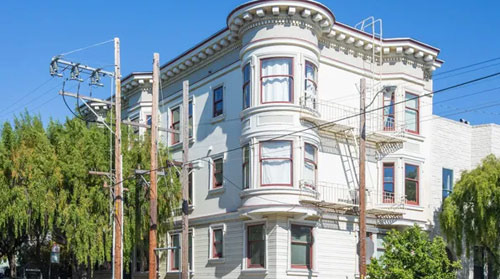
The rent for a 3-bedroom in San Francisco starts at around $4,600 per month, while the median price for a condo or townhouse of the same size is around $1.35 million.
To get straight to the point, if you plan to live in this city for less than 5 years, renting is more advantageous.
Let's start with the Price-to-Rent Ratio.
Dividing the median home price of $1.35 million by the annual rent of $55,200 gives us 24.5.
Generally, a ratio below 15 indicates that buying is favorable, while a ratio above 21 suggests that renting is more advantageous. A ratio of 24.5 clearly falls into the rental advantage category. This is evident. San Francisco has a market where home prices are excessively high compared to rents, and this structure has not changed significantly in recent years.
Let's confirm this with monthly payments. If you put down 20 percent, or $270,000, and borrow the remaining $1.08 million at a fixed rate of 6.75 percent for 30 years, the principal and interest alone would be about $7,005 per month. Adding property taxes of $1,238 and insurance of about $150 brings the total to around $8,392 per month. Since the rent for the same size is $4,600, this results in a monthly difference of $3,792. Over a year, that's more than $45,000. Whether to maintain this difference for 30 years depends on individual circumstances.
We also need to consider the opportunity cost of the $270,000 that could be used for a down payment. Even with a 6 percent return, this could yield over $16,000 a year. Choosing to rent and invest this money elsewhere is a perfectly reasonable calculation. Of course, the potential increase in home value should also be considered, but there is a perspective in the industry that additional growth potential is limited in an already overvalued market like San Francisco.
Comparing with nearby cities makes this gap even clearer. San Jose has a Price-to-Rent Ratio of 31.5, which is higher than San Francisco, and just moving slightly to Oakland or the East Bay generally results in lower rent burdens relative to home prices. Even within the Bay Area, the advantages and disadvantages can vary greatly by region, so broadening your commuting radius to compare options can be a good strategy.
- If you plan to stay for less than 5 years, renting is preferable.
- If you plan to settle for 10 years or more, buying may be worth considering.
- Check whether to invest the down payment funds.
- Assess if school districts or job locations are fixed.
If you plan to put down roots in this area for over 10 years and need to stick to a specific neighborhood for your children's schooling, the situation changes. Long-term residency can offset the higher monthly burden of buying through capital appreciation and principal repayment. Conversely, if there's a possibility of job change or relocation within 3 to 5 years, it's better to continue renting and invest any surplus funds. If you have sufficient financial capacity and can comfortably handle an $8,000 monthly payment, then buying may be a good option, but for most households, rushing into a purchase could be detrimental.
From the perspective of Korean households, San Francisco is often a city where they have to live due to children's education or careers in the tech industry. In such cases, rather than rushing to buy now, it's advisable to endure renting while continuing to build up the down payment, and wait for mortgage rates to drop below 6 percent. This is clear. There's no need to make hasty decisions in this market right now.
The figures reflect estimates based on market conditions as of the first half of 2026, and actual listings for sales and rentals may vary by neighborhood and building condition, so it's recommended to check the latest data on sites like Zillow and RentCafe and make final decisions based on your personal financial situation.
 joyfulroadtraveler2000
 SunnyBear




 |
| 
 Premium Gas Camp |
 CA Real Estate |
 cheesepup |
 breezem |

 my town K blog |
 Nuchuhan Exploration BLOG |
 Sirin Solitude and Advancing Hand in Hand |
 explorer |
  dictionary |
  Mr Bull Jung |
  radiant |
  Georgia 88 |
  Great TOWN NEWS |
  Open Flex Mind |
  Hartford Blog |
  unified |
  Generation X |
  ringwinds |
  American Food Information & Calories |
  Hawaii Maui Kahului |
  calvorn |
  fernando park |
  newyorker 101 |
  coffeee |
  |
|  Christopher |
  sylven |