

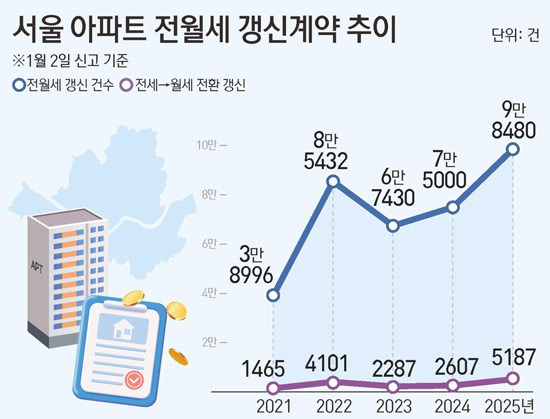
Listening to the real estate discussions in Seoul and the capital region can feel a bit unsettling right now.
The current situation can be summed up as "quiet yet strangely unsettling rising market."
As of March 2026, the official price of apartments in Seoul has risen by 18.67%.
However, once you step outside of Seoul, the atmosphere changes dramatically. The national average is only 3.37%.
It feels like there are completely different markets operating within the same country. Seoul has seen a significant increase, while the rest are in a slight decline.
The transaction prices are similar. The average apartment sale price in Seoul has increased by 0.08% weekly, while rent has risen by 0.12%.
Looking at the numbers alone, one might think, "What's the big deal? It's not much." But the direction is the issue. It continues to trend upward.
Why is this happening? The structure provides a clear answer.
The first factor is supply. It's not just a matter of being insufficient; it feels more like it's 'stuck.'
This year, about 29,000 housing units are expected to be completed in Seoul, which is over 30% less than last year. The situation in the entire capital region is not much different. It's only about half of the supply level deemed necessary.
This is the reality. Even just outside of Seoul, there are neighborhoods where redevelopment plans have been stagnant for 10 or 20 years.
Residents continue to wait, and plans keep getting postponed. Even if they want to build new homes, regulations, procedures, and interests are tangled, preventing any progress. Meanwhile, people keep moving in. Jobs are in Seoul, and infrastructure is concentrated there. Ultimately, supply is blocked while demand continues to build up. It's more unusual for prices not to rise.
The second factor is the strange reversal happening even within Seoul.
Typically, Gangnam leads the way while Gangbuk follows. However, right now, it feels the opposite.
Gangbuk has risen by 0.15%, while Gangnam is only at 0.03%. Looking at the numbers, Gangbuk seems to be hotter.
This isn't simply about "Gangbuk getting better." Gangnam is already so expensive that the number of people who can afford to enter is limited. Even if they want to buy, they can't. That's why prices are taking a breather.
In contrast, Gangbuk is different. There's still demand from people who are trying to get in at all costs.
Newlyweds, office workers, and those looking to upgrade are competing for the last remaining realistic options. This makes it more intense. Ultimately, the current market is one where "desperate people are more active than those with leisure."
The third factor is the change in rental agreements, which is the most noticeable aspect from an American perspective.
As properties with expired lease renewal rights hit the market, landlords are starting to crunch the numbers.
Instead of just raising the rent as before, they are considering, "Wouldn't it be better to turn this into a monthly rent?"
Rent ties up a large sum of money at once, but there's no monthly outflow. However, monthly rent is different. Money leaves the account every month.
This disrupts the entire structure of living expenses. Nowadays, discussions about "monthly rent burden" are becoming more pressing than home prices. As a rental culture like that in the U.S. takes hold, the scale of monthly living expenses increases, making life more difficult.
In summary, real estate in Seoul and the capital region is characterized by decreasing supply, intensifying competition for actual demand, and increasing pressure from rental costs.
Ultimately, the current real estate situation in South Korea is no longer just about whether prices are rising or falling. It has shifted to a question of who can enter the market and who is being pushed out.
From a distance, it may seem like a numbers game, but up close, it's simply a matter of life.
A home that the previous generation saved a lifetime to buy. Observing the current market makes it even clearer how significant that still is.




 cheesepup |
 breezem |
 yentra |
 virex |
 vexon87 |
 Best Frozen Yogurt |
 Aura-Infused WACAM |
 Heart Ticker |
 American Blog Forge |
 ultron78 |
  Kondae Garusong Blog |
  quiet river |
  shinee cho |
  alamo |
  Lol Life |
  Waiting for Godot |
  parlon |
  Say Yes in English |
  Sayonara H |
  rigid |
  Ohio Ohayoung Hello |
  U.S. Military Recruitment Information |
  You Turn Me On |
  DaeBak Electronics CNET |
  Anjollinya Blog |
  solid90 |
  elion |
  xylora |
  Study Abroad Life Know-How Tips |