

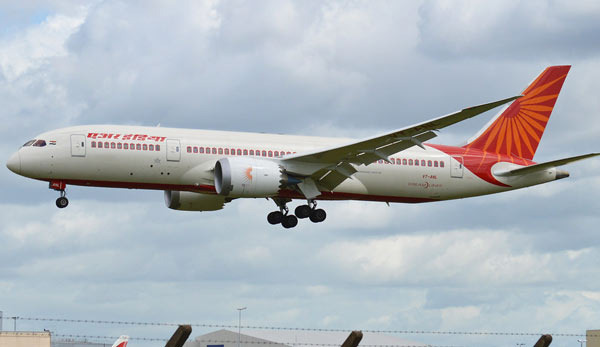
I was shocked while watching the news today. There was a report that a Boeing 787 Dreamliner crashed during takeoff at Ahmedabad Airport in India.
When taking off, the plane is loaded with fuel for long-distance flights, so if a malfunction or problem occurs at this point, the impact can cause the aircraft to break apart and the fuel tank to explode. Aviation fuel is slightly less volatile than regular car fuel, but if a large amount spills, the speed of fire spread is very fast, leading to much greater fire damage in confined spaces, buildings, or nearby residences than one might expect.
At 1:39 PM local time, this flight took off from runway 23, climbed only 625 feet, about 190 meters, before crashing and hitting a nearby medical school dormitory dining hall, resulting in an explosion. The aftermath caused significant damage to nearby hospitals and residential areas, affecting not only the passengers but also civilians on the ground.
The fact that the pilots shouted 'Mayday' right after takeoff suggests that something was detected as being wrong, but unfortunately, communication was lost shortly after. The landing gear of the accident aircraft was still extended, and the flaps were in a folded position, raising the possibility of a system malfunction or operational issue during takeoff.
The Boeing 787 Dreamliner is a medium-sized, long-range passenger aircraft known for its fuel efficiency and advanced technology. It uses a significant amount of carbon composite materials to reduce the weight of the aircraft and is considered an environmentally friendly model due to its latest engine technology that reduces noise and emissions. Since its first flight in 2011, it has been actively operated by airlines worldwide and is generally classified as a very safe aircraft.
However, in 2013, there was a temporary grounding of the aircraft worldwide due to battery overheating issues, after which improvements were made to the battery system and safety devices. Since then, no fatal accidents due to major aircraft defects have been reported, and most incidents or accidents have occurred due to external factors or pilot errors.
This incident in India appears to be influenced more by unexpected situations during takeoff and variables in piloting and management than by structural issues with the Dreamliner itself.
The only survivor rescued from the scene, British-Indian Vishwasi Kumar Ramesh, stated, "There was a loud noise just 30 seconds after takeoff, and it crashed before people had a chance to react." He managed to escape from the burning wreckage.
So far, 204 confirmed deaths have been reported from this accident. Among the passengers were 11 children and 2 infants, and many medical students who had gathered for lunch in the dormitory dining hall were also victims. Some reports suggest that there were no survivors among the 50 to 60 students present in the dining hall.
Hearing this news makes me acutely aware of the weight of the moment of 'airplane takeoff.' Many people consider mid-flight or landing to be more dangerous, but in fact, a significant number of aviation accidents occur just after takeoff or just before landing.
The reason is simple. An airplane must accelerate to maximum power on the runway to gain lift and ascend into the air. At this time, the altitude is low, and the speed is not completely stabilized, leaving almost no time to respond to small problems. Especially right after takeoff, the aircraft is fully loaded with fuel and is at its heaviest, so if a problem arises, the situation becomes more complicated.
Moreover, major city airports are usually close to residential or commercial areas, so if a crash occurs, the ground damage can be significant. Just like in this incident. The front of the aircraft hit the dining hall building, and part of the fuselage fell onto a building where families of doctors lived, forcing many to jump from the building to escape the fire.
Aviation accidents are always serious, but this incident that occurred simultaneously with takeoff is particularly heartbreaking.
An airplane flying in the sky. We take for granted the comfort of our seats, snacks, and movies during the journey, but in reality, all of this is the result of countless intersecting variables. Especially takeoff is a complex moment that requires the pilot's focus, the aircraft's condition, and weather conditions to align perfectly.
As someone who frequently flies, I often take a moment to breathe when taking off. I sometimes bow my head as if in quiet prayer. And every time I land and the seatbelt sign goes off, I feel a sense of relief inside.
This accident has claimed many lives and disrupted the daily lives of many families. But I hope it does not pass by simply as 'news from another country.' We all fly in the sky, but that safety comes not from technology but from 'vigilance.' We must not forget that every flight is a miracle.
Today, the sky is clear. And someone is taking off.
I pray again. Safely, without incident, to reach the destination.






 El Dorado |
 lightyear |
 Moscow Kim |
 coloradoman |
 Montgomery Mom |
 xylora |
 wendra |
 Texas Migration Story |
 Aura-Infused WACAM |
 ultron78 |
  Tonky |
  viroma |
  cookie |
  Live and that's it |
  Alright Twain |
  eatontown blog |
  HAWAII Korean Church News |
  Amore |
  linex |
  Balancework |
  laro90 |
  MEDBIO American Doctor Blog |
  SWAT TEAM BLK |
  DREAM BIG |
  frostbite |
  330 Forever My Love |
  dralix58 |
  Gorama Round |
  Skydiving |