

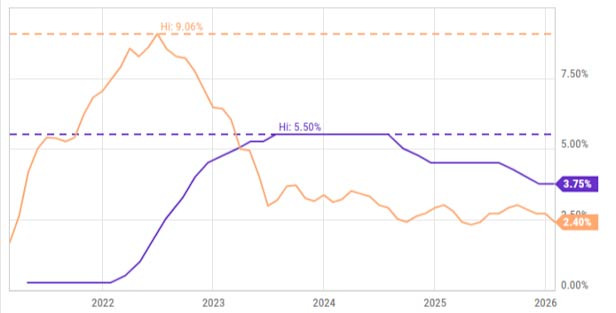
These days, many people sigh when they see their receipts after filling just a few carts at the grocery store, right?
Living in the U.S., the most sensitive issues are ultimately prices and interest rates, and the atmosphere is becoming quite concerning.
Originally, the Federal Reserve (Fed) was in a mood of taking a breather, saying, "Now that interest rate hikes are over, let's just see when we might lower them, right?"
However, prices are not stabilizing as expected, and with inflation rising again, there is a growing sense of tension within the Fed.
In the market, there are even public voices questioning whether instead of lowering rates, they might raise them again.
Especially the strong warnings about inflation risks are signals that we, like lambs, cannot afford to take lightly.
With the instability in the Middle East causing oil and energy prices to fluctuate, prices are being pushed up from below.
We all know that once prices rise, they do not easily come down.
Even if they decide to hold interest rates steady at the next meeting, the warning message that "we might raise them again if necessary" could freeze the market.
This is a frightening reality that directly impacts the dining tables and livelihoods of our Korean community.
The Deepening Sighs of Korean Small Business Owners
The small business owners, who make up a significant part of the Korean community, are likely already feeling this fear firsthand. If interest rates remain high or rise further, fixed costs such as business operation loan interest, credit card processing fees, and equipment leasing costs will all rise like dominoes, just from breathing.
Particularly in industries where many Koreans work, such as restaurants, grocery stores, laundries, and beauty supply shops, the daily cash flow is a lifeline. As prices rise, customers close their wallets, leading to decreased sales, while the burden of monthly bank interest payments grows exponentially, creating a structure where they bear the brunt of the impact. Even with hard work, a shocking situation arises where there is nothing left.
The Freezing Real Estate Market
The second major concern for our Koreans is real estate. You may have heard that home prices are slowly adjusting or that transactions have come to a halt, especially in major cities in Texas and California. With no signs of mortgage interest rates going down, those looking to buy homes have pulled back, and the sentiment has frozen solid.
Moreover, those who purchased rental properties as a retirement plan or side business are in a state of emergency. In a recession, tenant situations are predictable, so they cannot just raise rents, but their bank loan interest is increasing, leading to a worst-case scenario where their returns drop significantly, forcing them to inject their own money each month.
Employment Freeze for Workers
Employees working in companies are not exempt from this situation. If high interest rates persist, companies will first tighten their budgets and start downsizing. During next year's salary negotiations, they may offer minimal raises or even freeze new hiring.
Particularly in sectors where many Korean workers are concentrated, such as IT, logistics, trade, and services, the economy is already taking a direct hit and is slowly freezing up. While the paycheck coming into my wallet remains the same or is even precarious, fixed living costs like grocery prices and car insurance are skyrocketing, making it impossible to maintain quality of life.
On the Other Hand, Is There Opportunity for Those with Cash?
Of course, there are people who are smiling even in this dark tunnel. These are the ones who have maintained a high cash position without debt. When interest rates rise, the interest yields on bank deposits, money market funds (MMFs), and short-term government bonds become attractive. It's a time when simply holding cash earns interest safely without the hassle of tying it up in stocks or real estate.
However, to be honest, this is only the story of a few wealthy individuals with ample spare funds sitting in the bank; for the majority of ordinary Korean families who live diligently and wait for their paychecks each month, it sounds like someone else's story.
Ultimately, the current situation is not just a brief pause to avoid a storm. It's a tense period where "it could get cold again at any time, so we need to wear thick coats." Even if interest rates do not rise tomorrow, the mere signal that the Fed could change direction at any time means we need to build a defensive wall.
What the Korean community needs to do to survive right now is clear. We must reduce unnecessary dining out and impulse spending, and thoroughly cut down on hidden fixed costs (like subscription services or insurance premiums) that go out each month. Above all, if there are debts with variable interest rates, switching to fixed rates or paying down the principal first to restructure the debt is the most realistic and wise response.
Now is absolutely not the time to invest recklessly. Until the rain stops and the sky clears, we need to protect our assets firmly and build resilience with the mindset that "the one who endures wins." Everyone, keep a tight grip on your wallets and I wish you wisdom in navigating this challenge.
 OkElectronic
 DawnRose
 VanillaMoto




 NEXT ROUND |
 Encyclopedia of New York and Surrounding Areas |
 washington mom |
 California Dreamer |
 Sugar Cream Door Bulletproof Noodles |
 Study Abroad Life Know-How Tips |
 Sunny's Travel in America |

 novapixel |
 There Are Such Things in the World |
  Good News Good Thoughts |
  peelynew |
  Helpful Life Stories |
  chicpo |
  monorama tone |
  Kentucky Fried Chicken |
  bloomberg |
  morninpo |
  my town K blog |
  bravik31 |
  Various Knowledge and Information in the USA |
  orvik90 |
  San Gabriel Mountains |
  quanta7 |
  Fransco Family |
  leonee |
  Augusta 90 |
  Project Tomorrow |
  DOCTOR MED |
  Say IT Now |