
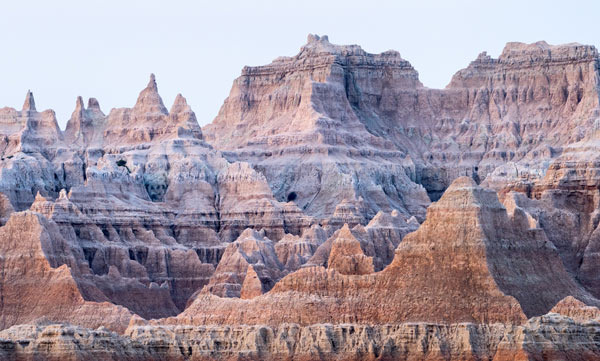
The land beneath South Dakota holds the long geological history of the North American continent.
The geology of this region begins with very old rock layers formed around 2.5 billion years ago, before the Paleozoic era. The Black Hills, located in the western part of the state, is the central area where geologists say you can see a variety of rocks from different eras, referring to it as the 'exposed timeline of North America.' At the heart of the Black Hills are Precambrian rocks such as gneiss and granite. These rocks are products from the time when the crust was first forming, making them traces of the early Earth.
Through millions of years of uplift and erosion, deep rocks have been exposed at the surface, surrounded by layers of limestone and sandstone formed during the Ordovician and Silurian periods. Thanks to this, the Black Hills region has a diverse array of rock colors and shapes, feeling like an outdoor geological museum.
Heading east, the landscape changes completely. The area east of the Missouri River features gentle plains, thickly layered with clay and gravel deposited during the Ice Age.
This area is covered with materials left behind as glaciers advanced and retreated, resulting in fertile soil and developed agriculture. In contrast, the western region, less affected by glaciers, has thinner soil and more exposed rocks. The Badlands National Park area is particularly famous for its unique layer shapes.
The strata here consist of sedimentary layers deposited around 30 million years ago during the Oligocene epoch, with unique colors created by the interplay of red, yellow, and gray clay and sandstone, resembling a massive painting. The sharp ridges and canyons formed by wind and water erosion are desolate like the surface of the moon, yet they hide numerous fossils within.
In fact, many fossils of ancient horses, camels, rhinoceroses, and large mammals have been discovered in this area, making it a center for paleontological research. Some areas in southwestern South Dakota also contain small amounts of resource layers such as coal and natural gas, but large-scale industrial development has not occurred. Instead, mineral resources such as gold, silver, copper, lead, and uranium have been found abundantly in the Black Hills.
The cities of Rapid City and Deadwood were established by people who flocked to this area during the gold rush of the late 19th century. Although most gold mines have closed over time, geologically, the land still holds rich mineral resources.
Thus, the geology of South Dakota serves as a natural history record showing all the changes from the birth of the Earth to the Ice Age and the human gold mining era.








 Dreams Come True as Desired |
 Dakota Man Blog Thanks |
 Tonky |
  viroma |
  cookie |
  Live and that's it |
  Alright Twain |
  eatontown blog |
  HAWAII Korean Church News |
  Amore |
  linex |
  Balancework |
  laro90 |
  MEDBIO American Doctor Blog |
  SWAT TEAM BLK |
  DREAM BIG |
  frostbite |
  330 Forever My Love |
  El Dorado |
  dralix58 |
  Gorama Round |
  Skydiving |