

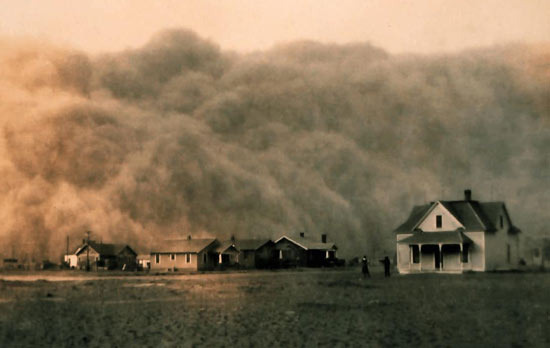
South Dakota was one of the areas affected by the Dust Bowl, a disaster that devastated farmers during the Great Depression in the 1930s. This environmental catastrophe shook the foundation of life for farmers in the region, and its traces remain in the prairies of South Dakota and in the memories of its people. The beginning was not so much a natural disaster as it was the result of excessive farming by humans.
From the 1910s to the 1920s, the American Midwest experienced an agricultural boom, referred to as the "Golden Plains." With the introduction of tractors and a rapid increase in arable land, vast prairies in South Dakota were transformed into wheat fields. At that time, the government encouraged settlers with the optimistic slogan "The rain follows the plow," but this was close to a superstition without scientific basis. It is hard to believe that just a hundred years ago, the government promoted such superstitions, but in a world where conspiracy theories thrive, it is not surprising.
Anyway, the short and sturdy roots of the prairie had held the soil for thousands of years and prevented erosion, but as all that grass was pulled out for farming, the land gradually weakened. Then, in the early 1930s, severe droughts caused by climate change followed. With almost no rain and only wind blowing, the fields quickly turned to dust. And that dust soon became a massive whirlwind that covered cities and towns.
In the spring of 1934, the skies of South Dakota darkened even during the day, and dust storms known as the "Black Blizzard" struck several times a week. Even with windows closed, dust seeped in, settling on beds, food, and even into people's lungs. Livestock collapsed from inhaling dust, and crops withered at the seed stage.
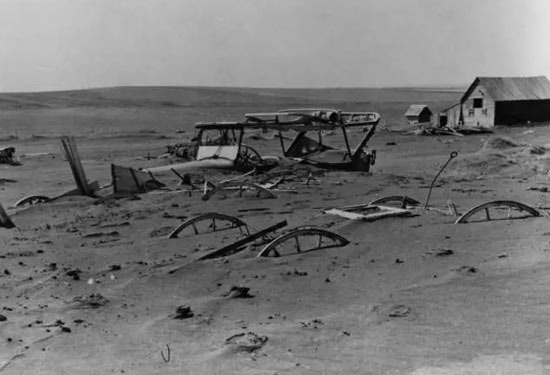
According to records from that time, some areas did not harvest a single grain of wheat in an entire year. As seen in the above photo, it was a terrible disaster where all farm produce was buried under piles of sand. It was said that with the technology and economic power of that time, restoration was beyond reach.
Ultimately, thousands of farmers and their families abandoned their farms and migrated westward. John Steinbeck's novel "The Grapes of Wrath" is set against this backdrop. In South Dakota, over 100,000 residents left for Nebraska, Wyoming, and California.
However, not everyone left. Those who remained began to seek new ways to protect the land. The government, belatedly realizing the seriousness of the problem, established the Soil Conservation Service in 1935. Across South Dakota, windbreak trees were planted, and the existing practice of plowing fields in one direction was changed to introduce new farming methods such as crop rotation and contour plowing.
Thanks to these efforts, by the mid-1940s, soil erosion gradually decreased, and the prairie ecosystem began to recover little by little. Today, when looking at the fields of South Dakota, the scars of that time have not completely disappeared. There are still wind-eroded hills and barren soil layers, and the elderly still share memories of "the day the dust storm came."
However, that ordeal left an important lesson for the people of South Dakota. They experienced firsthand the consequences of human greed that disregarded the order of nature. Therefore, today's farmers in this region prioritize soil management and environmental conservation as their most important values.
The Dust Bowl was a tragedy that devastated South Dakota, but it was also a turning point that redefined the relationship between land and people.





 Dreams Come True as Desired |

 Dakota Man Blog Thanks |
 Mr. Midwest America |
  manchester |
  constant |
  Leapfrog Move |
  vibranto |
  Tora Tora |
  yellowbutter |
  Dolly |
  US Embassy |
  NYC saladbar |
  Finding Superfoods |
  lightyear |
  song bang |
  vexomo |
  Indiana Jones |
  meloncat |
  novapixel |
  mortrix |
  Esther 1983 |
  fortbliss |
  Moscow Kim |