

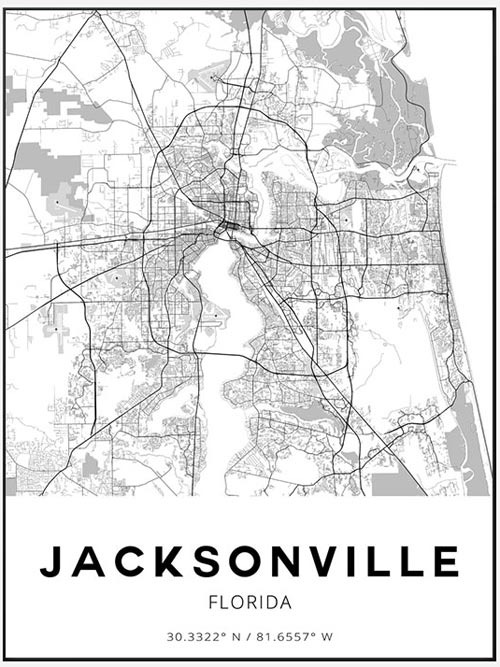
Looking into the history of Jacksonville, it becomes clear that this city is more than just a port city; it embodies the changes of northern Florida. Located at the mouth of the St. Johns River, Jacksonville has always been a hub of transportation and exchange.
Before the arrival of Europeans, this area was the land of the Timucua Indian tribe. They established villages along the river, living by fishing, hunting, and farming. The St. Johns River was their source of life and the center of their existence, and the present-day downtown Jacksonville was their main residence.
In the mid-16th century, the arrival of French explorers marked the beginning of a new chapter in history. In 1564, French Huguenots built a fort called 'Fort Caroline' at the mouth of the St. Johns River, but it was attacked by Spanish forces and disappeared within a year. After that, the area came under Spanish rule, where Catholic missions and trade took place. In the 18th century, the British briefly occupied the area, and it became Spanish again, leading to a complex colonial history. Ultimately, in 1821, Florida became part of the United States, and the name Jacksonville began to emerge.
The name 'Jacksonville' was given in honor of Andrew Jackson, a hero of the time and the seventh president of the United States. He was the one who acquired Florida from Spain and was a symbolic figure of southern expansion. The city was officially established in 1822, and from then on, Jacksonville began to grow as a commercial port and transportation hub. The St. Johns River was deep and wide enough for large vessels, facilitating the active import and export of timber, cotton, and seafood.
In the late 19th century, the introduction of railroads accelerated development even further. However, in 1901, a catastrophic event known as the Great Fire of 1901 devastated most of the city. It was the largest urban fire in the southern United States at the time, destroying over 2,000 buildings. Yet, the people of Jacksonville rebuilt their city from the ashes. Subsequently, reinforced structures and brick buildings emerged, transforming it into a modern city, and by the mid-20th century, the addition of a naval base and port industry helped the economy rise again.
Jacksonville's population is very diverse. It is known for its mix of white, black, Hispanic, and Asian residents, with a notably high percentage of black population. The Korean population, while not large in proportion to the total population, is steadily increasing.
Recent statistics indicate that about 2,500 to 3,000 Koreans reside in Jacksonville and the surrounding areas, with a steady increase in Korean churches, restaurants, and markets. They are primarily composed of doctors, engineers, business owners, and military personnel, often settling as families.





 fortbliss |
 Folding Instructions |
 yentra |
 Cali M Law Group |
 quanta7 |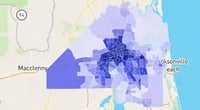
 Taco Bell Candy Note Blog |
 Mia Flori |
 Well Done Sir |
 oh my salami |
  Korean Mom |
  My NYC |
  moo moo |
  Mr Oh |
  forevergee |
  festival |
  manchester |
  constant |
  Leapfrog Move |
  vibranto |
  Tora Tora |
  yellowbutter |
  Dolly |
  US Embassy |
  NYC saladbar |
  Finding Superfoods |
  lightyear |
  song bang |
  vexomo |
  Indiana Jones |