

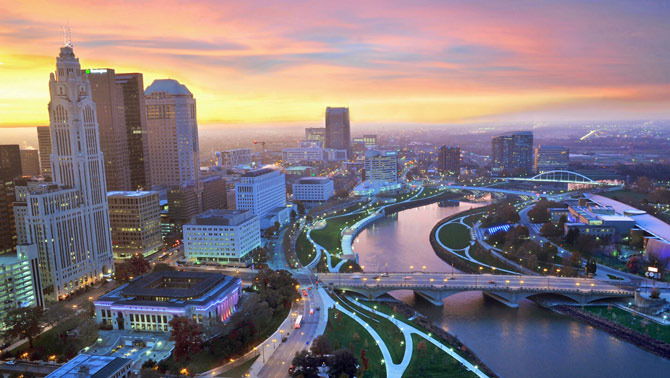
The reason the Columbus area is considered one of the fastest growing regions in the Midwest is due to its balanced industrial structure. Various industries, including manufacturing, finance, healthcare, education, IT, and logistics, are evenly distributed, making it a city resilient to economic fluctuations.
First, the representative industries of Columbus are insurance and finance.
Large financial companies such as Nationwide Insurance, Huntington Bank, and JPMorgan Chase have their headquarters or large offices here. As a result, jobs in various fields such as accounting, law, data management, and customer service are consistently supplied. The stable employment structure created by these companies forms the backbone of the city's economy.
Another notable sector is healthcare and pharmaceuticals.
The Ohio State University Wexner Medical Center is the largest healthcare institution in the region and a research-focused hospital. With hospital groups like Nationwide Children's Hospital and OhioHealth, Columbus has developed its healthcare industry to the extent that it is referred to as a 'medical city.' Research in life sciences, biotech, and rehabilitation technologies is particularly active, leading to the continuous emergence of related startups.
The IT and technology industries are also growing rapidly.
In recent years, global companies like Google, Amazon, and Meta have established data centers near Columbus, making it an emerging hub for advanced industries. Investments from these large corporations have stimulated the overall technology ecosystem in the city, and small IT companies and software development firms are also actively entering the market.
In particular, the 'Smart Columbus' urban innovation project is experimenting with smart city models by integrating technology into transportation, energy, and environmental systems. In fact, Columbus is one of the first cities in the nation to start building infrastructure for autonomous buses and electric vehicles.
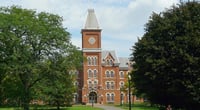
Additionally, the presence of Ohio State University (OSU) plays a significant role in the development of the local industry.
This university is a top research institution in engineering, business, healthcare, and agriculture in the United States, and collaborative research with companies is active. The talent and research facilities the university possesses drive the growth of local startups, and many graduates build their careers here, remaining in the area. This 'continuous talent circulation structure' is a crucial factor enhancing the stability of Columbus's economy.
Manufacturing still holds a significant share.
Companies like Honda and Worthington Industries produce automotive parts and steel in the Columbus area, and in logistics and distribution, large logistics centers are concentrated, taking advantage of the Midwest's geographical advantages. The city's structure, where major highways like I-70, I-71, and I-270 intersect, allows for fast and efficient logistics movement, making it a central hub for national distribution. Recently, creative industries such as film, design, and marketing have also been growing.
Especially around Short North and Downtown, there are many co-working spaces where artists and startups work together, and the city has enhanced its support to attract 'creative jobs,' making the atmosphere even younger. In summary, Columbus is a 'balanced industrial city.' Built on a traditional manufacturing base, finance, healthcare, IT, and creative industries are naturally layered, so even if one sector shakes, the entire city does not easily become unstable.
With a clean urban environment, stable living costs, and excellent educational infrastructure, it has established itself as a place where both companies and talent want to stay. Therefore, Columbus is being evaluated as the next growth city that will lead the economy of the Midwest in the future.


 moo moo |
 ultron78 |
 garlic bread |
 Sugar Cream Door Bulletproof Noodles |
 urbanmint |
  Ohio Ohayoung Hello |
 fixed |
 Tonky |
  viroma |
  cookie |
  Live and that's it |
  Alright Twain |
  eatontown blog |
  HAWAII Korean Church News |
  Amore |
  linex |
  Balancework |
  laro90 |
  MEDBIO American Doctor Blog |
  SWAT TEAM BLK |
  DREAM BIG |
  frostbite |
  330 Forever My Love |
  El Dorado |
  dralix58 |
  Gorama Round |
  Skydiving |