

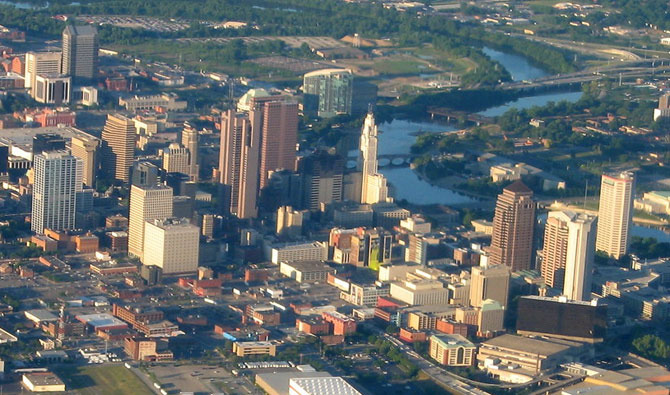
The population of Columbus is about 930,000, and when including the metropolitan area, it exceeds 2.2 million. Over the past decade, the population has steadily increased, making it the second fastest-growing city in the Midwest after Chicago.
This city is a multicultural hub where various ethnicities coexist. Whites make up about 55%, followed by around 30% Black, about 7% Asian, and approximately 6% Hispanic. Due to the large and internationally renowned Ohio State University (OSU), many global talents, including international students, researchers, and skilled workers, are drawn to the area.
As a result, you can easily find restaurants from countries like Korea, India, China, Vietnam, and Mexico throughout the city, and various cultural events are held. Economically, Columbus is a prime example of a city that has transformed from a traditional manufacturing base to a knowledge industry hub. Once a city centered around factories and logistics, it is now driven by technology, education, healthcare, insurance, and finance. Major corporations like Nationwide, JPMorgan Chase, Cardinal Health, and Huntington Bank have their headquarters here, and recently, global IT companies like Google, Amazon, and Facebook have been increasing their investments by establishing data centers.
Thanks to these changes, the job market is stable, and the middle class is well-maintained. The average household income is around $70,000, which is higher than the Ohio state average and close to the national average. The relatively low cost of living means that the real purchasing power is even higher. Notably, the real estate market has not yet skyrocketed.
Just a little outside the downtown area, you can find decent apartments for under $1,500 in rent, and single-family homes can be purchased for around $300,000. Transportation is facilitated by major highways like I-70, I-71, and I-270, making it a logistics and distribution hub. This geographical advantage makes it very suitable for companies to establish their headquarters or logistics centers.
Additionally, plans are underway to expand John Glenn Columbus International Airport, which is expected to increase demand in both the logistics industry and travel in the future. Another driving force behind local economic growth is education. Ohio State University (OSU) has over 60,000 students, and related research facilities and startup ecosystems are forming throughout the city.
Startups related to IT, healthcare, and energy are rapidly growing around OSU, which is helping to retain young talent in the city. Columbus is also actively supporting startups and entrepreneurs, earning the nickname "Silicon Valley of the Midwest." The city atmosphere is increasingly youthful and sophisticated while maintaining the unique stability of the Midwest. Areas like German Village, Short North, and Arena District are economically vibrant and culturally rich.
Thanks to this balanced growth, Columbus is often mentioned as "one of the most economically healthy cities in the U.S." In summary, Columbus is a vibrant city with a stable economic structure, affordable living costs, and a diverse population. Shedding its past image as an industrial city, it is growing into a new Midwest model centered on innovation and diversity.







 moo moo |
 ultron78 |
 garlic bread |
 Sugar Cream Door Bulletproof Noodles |
 urbanmint |
 fixed |
  Ohio Ohayoung Hello |


 US Embassy |
  Korean Mom |
  My NYC |
  Mr Oh |
  forevergee |
  festival |
  manchester |
  constant |
  Leapfrog Move |
  vibranto |
  Tora Tora |
  yellowbutter |
  Dolly |
  NYC saladbar |
  Finding Superfoods |
  lightyear |
  song bang |
  vexomo |
  Indiana Jones |