

Today's topic is about two expressions that are strangely hard for us Koreans to use.
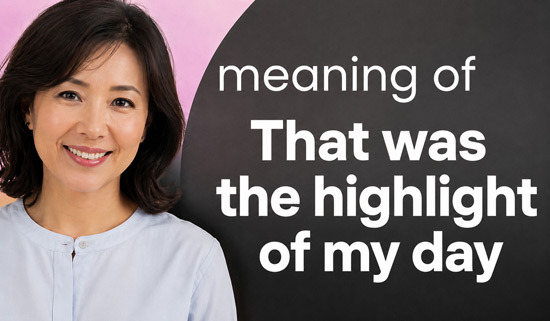
They are "You made my day." and "That was the highlight of my day."
You've probably heard these phrases a lot in TV shows or movies, right?
But when it comes to using them, they can feel awkward.
If you try to translate these phrases directly into Korean, it can really confuse your brain.
You made my day -> 너는 내 하루를 만들었어. (?)
That was the highlight of my day -> 그것은 내 하루의 하이라이트였어. (?)
What do you think? Saying it like this in Korean feels a bit awkward and exaggerated, doesn't it?
If you say, "You made my day!" in a casual conversation in Korea, people would probably look at you like, what are you talking about?
However, in American English, it's not an awkward expression at all!
It actually means, "Thanks to you, I feel great today!" or "This was the best part of my day!" It's a very natural way to express gratitude and joy in everyday conversation.
When you feel good because of someone: "You made my day!"
This expression is used when you feel that your entire day has been made better because of someone's small action or kind words.
You don't have to do something huge to use it! It fits perfectly for small compliments or unexpected kindness.
Let me show you some real-life situations where this is commonly used.
Situation A: When you're touched at a café
Imagine you've been waiting a long time at a busy café, and the staff hands you a complimentary chocolate cookie to apologize for the wait.
Staff: "Sorry for the wait, here is a free cookie for you!"
Me: "Oh, wow! You just made my day! Thank you so much!"
Situation B: An unexpected compliment from a colleague
When you arrive at work and a colleague compliments your new dress, just saying "Thank you" feels a bit dull, right?
Colleague: "I love your dress! You look stunning today."
Me: "Aww, you made my day. I was actually feeling a bit down."
Situation C: Receiving a sweet text message
On a tiring afternoon, receiving a warm text from a friend or partner is a perfect time to use this expression in your reply.
Example: "Your sweet text really made my day."
Sweet version: "Seeing your smile this morning made my day."
The best moment of the day: "That was the highlight of my day."
Now, let's look at the expression that includes the word 'highlight.'
This expression is great for pinpointing a 'specific event or moment.' It conveys the nuance of, "There were many things today, but this was definitely the best!" You often hear this in movies.
Let's look at some examples.
Situation A: After a fun lunch with a friend
You can use this when you take a break from your busy life to have a nice meal and chat with a friend before parting ways.
Me: "Thanks for meeting me. Lunch with you was the highlight of my day."
Situation B: When seeing a drawing your child brought home from school
There's no better compliment for moms than to uplift their kids at home.
Child: "Mom, look what I drew in school today!"
Mom: "Oh sweetie, this is beautiful! This is the highlight of my day!"
Situation C: When you have a wonderful experience
You can also use this expression when you see a beautiful sky on your way home or enjoy a fantastic performance.
Example: "Watching the sunset at the beach was the highlight of my day."
Let me clarify the difference between the two expressions!
Still confused? Let me summarize it in a way that sticks!
You made my day
Core nuance: "You lifted my spirits!" (Emotional, expressing gratitude)
Commonly used for: People or their actions (You, Your text)The highlight of my day
Core nuance: "This was the best thing that happened today!" (Event-focused)
Commonly used for: Experiences, events, things (Lunch, Concert, This)
For example, if someone remembered my birthday and sent me a card, I would feel grateful for that person, so saying, "You remembered my birthday? You made my day!" feels much more natural.
On the other hand, when reminiscing about the 'experience' of going out with friends to see the night view on the weekend, saying, "Going to the viewpoint was the highlight of my day." is the correct way to express it.
Some people worry that these expressions are too casual to use in the workplace. That's absolutely not true!
In fact, they serve as a lubricant to soften a stiff atmosphere.
When a boss praises my work
Boss: "Great job on the presentation today, Kim."
Me: "Thank you so much. That really made my day."
When a customer leaves a touching review (email reply)
Example: "Thank you for your wonderful feedback. Your kind words made our day."
Quick American-style reaction tips
You don't always have to write long sentences. When a friend sends a hilarious meme or a cute cat video in a group chat, throw in a quick comment.
"Haha, that made my day."
"Seriously, that made my day."
The charm of American English lies in this.
You don't need to use complicated or grand words; it's all about expressions that touch on the subtle emotions that native speakers feel in their daily lives.
When we want to express gratitude in English, we often just recycle "Thank you" or "Thank you so much". Let's expand our spectrum a bit!
However, Americans like compliments but also don't overdo them. So, remember that "You made my day" should only be used when someone truly makes you feel good.
In ordinary situations, it might come off as a bit too much, so keep that in mind.
 ORAVEZIN
 SteveRespect
 PuddingBuddy
 SendMeGigs







 Balancework |
 Make My Day |
 viroma |
 eatontown blog |
 Toaster Pizza Magic Show |
 Baguette Blog |
 Snack-like Blog Writing |
 Until the Day It Gets Better |
 Sunny Sunny with the Sun |
 silverpath |
  Komet Park |
  reliable |
  vexo90 |
  As Always Today |
  veltar87 |
  United States National Administrative Organization Stories |
  springwaltz |
  dense |
  Tiger Milk Foam Research Institute |
  Oreore Mushroom |
  optimistic |
  Good Good |
  berion88 |
  bravo777 |
  skyblue |
  Project Tomorrow |
  apricotla |
  Soy Angelino |
  nati8 |