

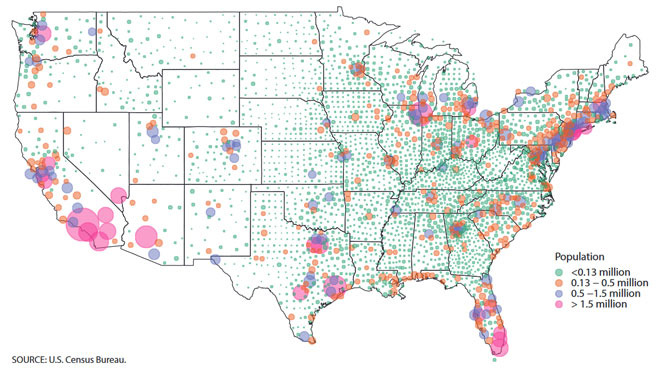
It is well known that the United States is vast, with varying climates, cultures, and economic levels across the country, yet the residences of Americans are quite concentrated.
Statistics show that nearly one-third of the U.S. population, or one in three people, lives in just five states.
California, New York, Florida, Texas, and Illinois. While one might think, 'These are just famous states,' examining the commonalities and differences among these five states provides insight into the structure of the United States and why people cluster in certain areas.
When looking at the states where people congregate in the U.S., clear commonalities emerge. First, there are many job opportunities. The more diverse the industries—such as technology, finance, manufacturing, and tourism—and the more companies that continue to flow in, the more the population follows. Second, transportation and education/healthcare infrastructure are robust. Finally, culture, climate, and diversity play significant roles in helping people find "reasons to live" in these concentrated areas.
Let's start with California. It is a representative large state that has everything: population, economic power, technology industries, and entertainment. From Silicon Valley to Hollywood, it is a place where innovation and culture converge, naturally attracting people. The weather is also pleasant. Consequently, California is a place where great opportunities come with high living costs. It is a dream stage where anyone can challenge themselves, but at the same time, many businesses and individuals are moving to other states due to high living costs and regulations, showcasing its dual nature.
Next is New York. When people think of New York State, they often only think of New York City, but in reality, the state includes the outskirts and northern regions. Still, this state ranks high in U.S. population primarily due to the overwhelming influence of New York City. Industries connected to the world, such as finance, advertising, fashion, art, and international business, attract young talent from around the globe. However, New York is closer to being a city where 'success is visible if you survive' rather than a place that is simply pleasant to live in.
In contrast, Florida has a completely different atmosphere. Its warm weather, reputation as a paradise for retirees, and its status as a hub for tourism and recreation are distinctive features. However, it cannot be viewed solely as a vacation destination; recently, due to tax policies and housing prices, younger people and businesses are also relocating. Particularly, cities along the eastern coastline are growing rapidly, and the strong multicultural atmosphere, with a significant population from South America, adds to Florida's unique appeal.
Texas is a large state with a distinct character. With a solid industrial base in oil, technology, defense, manufacturing, and logistics, job opportunities continue to flow in, and housing prices are relatively low, leading to explosive population growth. The movement of businesses also plays a role here. As the West and East begin to get more expensive, Texas has emerged as a 'land of new opportunities.' Thanks to its vast land and relaxed regulations, it attracts startups, large corporations, and immigrants alike.
Finally, Illinois. As a state that houses the major city of Chicago, it serves as an economic hub for the entire Midwest. Logistics, finance, education, healthcare, and manufacturing are evenly developed, and it is a transportation center connected to Indiana, Michigan, and Wisconsin, maintaining a steady population. Notably, Chicago's multiculturalism creates a unique atmosphere where diverse people live together, rivaling that of New York.
The fact that one-third of Americans live in these five states ultimately means that the U.S. population is concentrated in areas where "opportunities exist."
People often say which states are good or comfortable to live in, but my conclusion is simple. No matter where you live, "living well in your own place is the best life."
Some regions have many jobs, some are quiet, and some have affordable housing and good weather, but there is no guarantee that the conditions others envy will fit perfectly into my life. Life is not a vacation but everyday reality, and satisfaction arises when the environment I encounter daily is comfortable for me. The moments of having a favorite grocery store nearby, a park I can regularly visit, friendly neighbors, and a rhythm of work and life that aligns ultimately seem to create a "good life."






 Korean Mom |
 novapixel |
 Peter Pan Pet |
 horse |
 Sunset Oregon |
 Tart Tart |
 tiramisu |
 bagel90 |
 lattecu |
  NO CAP LIFE |
  DREAM BIG |
  frostbite |
  330 Forever My Love |
  El Dorado |
  dralix58 |
  Gorama Round |
  Skydiving |
  dreamport |
  Yellow Snowman |
  Toaster Pizza Magic Show |
  velvetnom |
  Anytime Journey |
  Mrs. Duluth |
  jaxter |
  Atlanta Mama |
  Baguette Blog |
  Tan Sol |
  US Embassy |
  My NYC |