
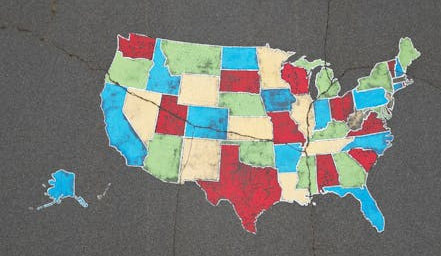
The United States is made up of 50 states, and the population of each state has a significant impact on the economy, culture, and politics.
According to the 2022 U.S. Census Bureau data, the top 10 states with the largest populations are as follows:
- California: approximately 39,029,342 people
- Texas: approximately 30,029,572 people
- Florida: approximately 22,244,823 people
- New York: approximately 19,677,151 people
- Pennsylvania: approximately 12,972,008 people
- Illinois: approximately 12,582,032 people
- Ohio: approximately 11,756,058 people
- Georgia: approximately 10,912,876 people
- North Carolina: approximately 10,698,973 people
- Michigan: approximately 10,034,113 people
The total population of these 10 states accounts for a significant portion of the entire U.S. population, and each state has its own unique economic and cultural characteristics.
- California: Known for its technology industry represented by Silicon Valley and the entertainment industry of Hollywood.
- Texas: The energy industry (oil and natural gas) and agriculture are the main industries.
- Florida: Tourism and agriculture make up a large part of the economy.
- New York: A hub for finance (Wall Street) and the media industry.
- Pennsylvania: Manufacturing and agriculture are the main industries.
- Illinois: Finance and manufacturing have developed around Chicago.
- Ohio: The automotive industry and agriculture are key to the economy.
- Georgia: Logistics and the film industry are growing around Atlanta.
- North Carolina: Finance and research and development (RTP area) are the main industries.
- Michigan: Known as the center of the automotive industry.
This population distribution and industrial characteristics have a significant impact on the economy and culture of the United States, playing an important role in the policies and development directions of each state.








 Weekend Movie Blog |
 Beauty, Health, Lifestyle Blog |
 coloradoman |
 Superman Cat Blog |
 Victory 1988 |
  Korean Mom |
  My NYC |
  moo moo |
  Mr Oh |
  forevergee |
  festival |
  manchester |
  constant |
  Leapfrog Move |
  vibranto |
  Tora Tora |
  yellowbutter |
  Dolly |
  US Embassy |
  NYC saladbar |
  Finding Superfoods |
  lightyear |
  song bang |
  vexomo |
  Indiana Jones |