

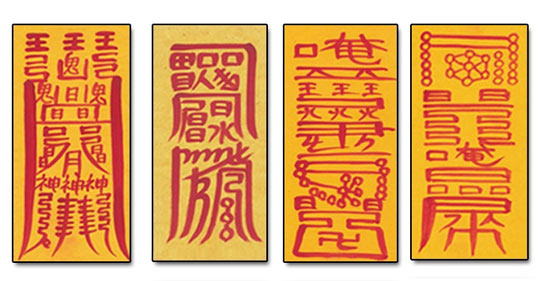
Throughout history, humanity has had one commonality, regardless of where they were born or what gods they believed in.
That is, they wanted to create objects like 'talismans' to carry on their bodies or keep in their homes, seeking to borrow invisible powers.
The talismans familiar in Korea and China are used to ward off ominous energies, but in fact, similar concepts existed in Western societies as well.
In the West, during the medieval period, there were 'amulets' and 'talismans.'
However, there is an important distinction here. The sacramentals used in Catholicism, such as holy relics, rosaries, crosses, and the 'Miraculous Medal,' are not 'talismans' as commonly misunderstood.
In Catholicism, there is no concept of a talisman that wards off evil spirits or brings blessings. Rosaries and crosses are not objects with magical powers; they are merely tools for prayer that seek God's grace.
Sacramentals are used as auxiliary tools to aid in the practice of faith, and treating them as talismans or having blind faith in them is considered superstitious behavior that should be avoided. Ultimately, the difference in Catholicism is clear: sacramentals are not 'magical shields' but 'mediators that guide prayer and faith.'
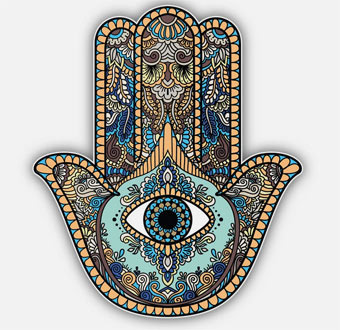
In the Islamic world of the Middle East, the 'Hamsa' (Hand of Fatima) is a representative hand-shaped talisman.
It is still hung on doors or cars today, believed to ward off the evil eye.
African tribes believed that animal bones or stones contained the power of spirits, so they made them into necklaces to wear, while among Native Americans in North America, the 'dreamcatcher' is famous. It is a net-like ornament believed to filter out nightmares and leave only good dreams.
Even when people set out to sea, the concept of talismans was not absent.The eye-shaped ornament carved on the bow of ancient Greek ships symbolized that 'the god of the sea protects the way,' and the dragon-headed ornament of the Vikings was thought to protect the ship by threatening evil spirits and enemies.
In Eastern ships, sacred animals like dragons, phoenixes, and turtles were also carved to calm storms and pray for safe returns. Ultimately, the bow ornament was not just a decoration but a talisman for ancient people seeking stability in the uncertain world of the sea.
At this point, an interesting question arises.
Why did humans create similar 'talismans' across different cultural spheres? The answer is surprisingly simple yet profound.
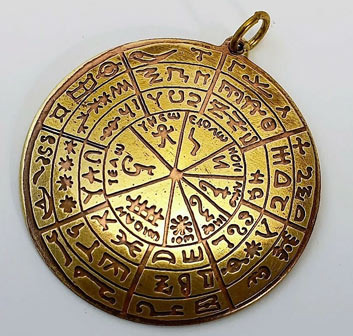
It is due to uncertainty. From birth, humans are faced with uncontrollable events such as illness, accidents, and wars.
At this time, since there are no rational solutions, a psychological device was needed. Talismans served as invisible 'seatbelts,' acting as tools to manage anxiety.
Philosophically, talismans can be seen as humanity's attempt to balance itself with the universe. Just as Plato spoke of ideals, there is a belief in an invisible perfect world, and in the East, harmony of yin and yang is emphasized.
Ultimately, people projected their lack of power in reality onto symbols to find balance in their hearts. They found comfort in the thought that "I can still manage the uncontrollable world a little bit."
Another interesting point is that talismans contributed not only to individual reassurance but also to community cohesion. By sharing the same talisman or using it together in rituals, they confirmed a sense of belonging, saying, "We rely on the same power." The 'collective consciousness' that philosopher Durkheim spoke of is likely in this context.
In the end, talismans are not merely products of superstition but one of the ways humans confront anxiety and relate to the world. Even now, as science has advanced, people still wear lucky bracelets and hang small decorations in their cars.
These can all be considered modern talismans. However, unlike sacramentals used in religious faith, talismans rely on 'magical power,' while sacramentals are connected to 'God's grace and prayer,' and it is important to clearly understand this difference.
Perhaps talismans are an expression of an unending human instinct, a desire to create a safety net for the mind in an uncertain world.
However, distinguishing this without confusion within faith and understanding its true meaning may be an even more important attitude for modern people.






 Weekend Movie Blog |
 Beauty, Health, Lifestyle Blog |
 coloradoman |
 Superman Cat Blog |
 Victory 1988 |
  Korean Mom |
  My NYC |
  moo moo |
  Mr Oh |
  forevergee |
  festival |
  manchester |
  constant |
  Leapfrog Move |
  vibranto |
  Tora Tora |
  yellowbutter |
  Dolly |
  US Embassy |
  NYC saladbar |
  Finding Superfoods |
  lightyear |
  song bang |
  vexomo |
  Indiana Jones |