
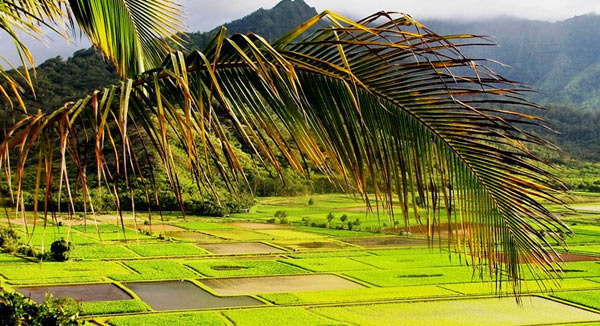
When you think of Hawaii, you usually think of vacation spots, but it has a deep agricultural history, often referred to as the 'farm of the Pacific.'
Among them, Maui and Oʻahu islands play a significant role in the local economy alongside the tourism industry. However, the agricultural environments and industrial structures of the two islands are quite different. One can be seen as 'traditional and natural agriculture,' while the other is 'urban smart agriculture.'
The interesting aspect of agriculture on these two islands is that tourism and agriculture do not compete but enhance each other's value. In Maui, tourists visit farms to drink Hawaiian coffee, while in Oʻahu, hydroponically grown lettuce is served on restaurant tables right in the city center. Although the methods differ, ultimately, 'fresh produce grown by locals' is becoming a new strength of Hawaii's economy.
First, let's talk about Maui. Historically, Maui has been the center of sugarcane and pineapple agriculture. In fact, until the mid-20th century, more than half of Hawaii's economy was driven by sugarcane. The wide plains, volcanic soil, and stable rainfall in Maui were very suitable for crop cultivation. In the Kahului and Paia areas, there was once the world's largest sugarcane plantation, and the Maui Sugar Company operated for over 140 years until it closed in 2016. Although large-scale plantations have now disappeared, small organic farms and community-based agricultural cooperatives have taken their place.
Recently, what stands out in Maui is 'Agritourism.' Farms that grow Hawaiian coffee, macadamia nuts, lavender, papayas, and tropical fruits are open to tourists, allowing them to experience it firsthand. The Upcountry region of Maui, especially Kula, is located at a high altitude, making the air clear and the soil fertile. As a result, lavender farms, vineyards, and mini wineries have emerged, creating a 'resort in the countryside' atmosphere. Local farmers emphasize "small but quality" and have shifted towards sustainable agriculture based on the community rather than corporate farming.
On the other hand, Oʻahu presents a completely different picture. Oʻahu is the island where Hawaii's capital, Honolulu, is located, and two-thirds of the population is concentrated here. Therefore, the focus is more on the service and technology industries rather than agriculture, but urban farming is rapidly spreading. In particular, small to medium-sized farms are still actively operating in the outskirts of Honolulu, such as Waiʻanae, Wahiawā, and the North Shore area.
Oʻahu's agriculture is characterized by 'technology' and 'sustainability.' Farms incorporating advanced technologies such as hydroponics, smart farms, and solar greenhouses are increasing even within the city. For example, in the Wahiawā area, there are indoor vegetable farms that use artificial intelligence to control temperature, humidity, and nutrients, and the University of Hawaiʻi at Mānoa has a dedicated program for researching urban agriculture. Farmers in Oʻahu are not just farming; they aim for 'food self-sufficiency within the city.' This is due to the growing consensus that food production needs to occur locally, especially after the disruptions in the food supply chain during the pandemic.
Additionally, Oʻahu has active 'green startups' involving young entrepreneurs. New ideas such as rooftop vegetable gardens, vertical farms, and seaweed-based food businesses are emerging. These urban farming models are also attracting significant interest from tourists. They are evolving into 'tourism that experiences agriculture' by combining farm tours with local food experiences.
In summary, the difference between the two islands can be encapsulated as Maui being 'nature-centered traditional agriculture' and Oʻahu being 'technology-centered urban agriculture.'





 Hani 1977 |
 Mau Nui |
 Hawaii Tourist Information |

 DREAM BIG |
  frostbite |
  330 Forever My Love |
  El Dorado |
  dralix58 |
  Gorama Round |
  Skydiving |
  dreamport |
  Yellow Snowman |
  Toaster Pizza Magic Show |
  velvetnom |
  Anytime Journey |
  Mrs. Duluth |
  jaxter |
  Atlanta Mama |
  Baguette Blog |
  Tan Sol |
  US Embassy |
  Korean Mom |
  My NYC |