

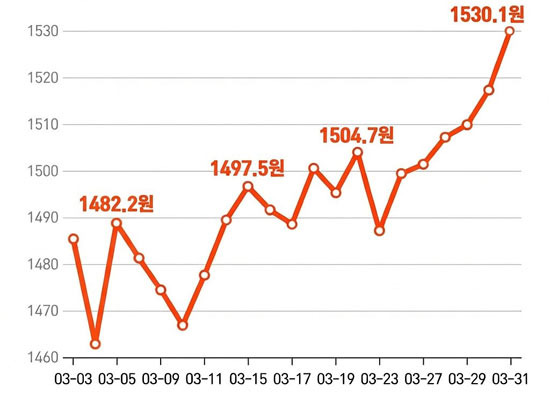
These days, the Korean community is constantly talking about the exchange rate.
"It hit 1,530 won," "Now is the time to send money," "Should I send Korean money?" There are many such comments.
From the atmosphere, it feels like everyone is excited as if an opportunity has come.
But during times like this, there's something we need to look at first.
"Why did this number come out?" That's the question.
The reason the exchange rate has risen is not simple. It's a situation where Middle East risks, rising oil prices, and global capital movements have coincided.
To put it simply, as uncertainty increases, money flows into dollars. So, the won is continuously being sold, and dollars are continuously being bought.
What's more important here is the foreign exchange loss. When the won falls, from a foreigner's perspective, the value of the money invested in Korea decreases when converted to dollars.
"Let's sell quickly before it falls more." Then they sell stocks, convert to dollars, and the exchange rate rises further. This cycle continues. It's a complete vicious cycle.
There's also something unusual about the current situation. Normally, when the dollar weakens, the won should also take a breather, but there's no such reaction now.
As foreign capital exits, the won is falling further on its own. It's literally a situation where the won is taking all the hits.
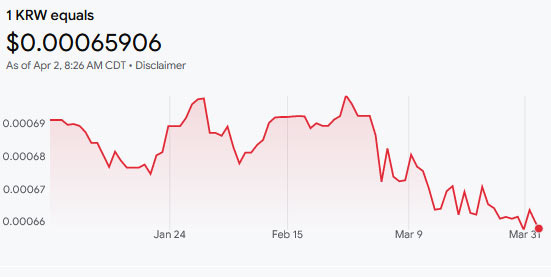
So, what does this mean for Koreans living in the U.S.? "Partially, it's advantageous."
For those receiving salaries in dollars, this is definitely a plus.
Previously, when it was 1,200 won, sending 1,000 dollars meant 1.2 million won. Now it's 1.5 million won.
It's the same amount of money, but you're sending 25% more. If it's for living expenses for parents or paying off loans in Korea, the current exchange rate is definitely a good timing.
The same goes for asset values. Those holding dollars are in a position of increased purchasing power on a global scale.
From a Korean perspective, the feeling is much greater. This is something that can be confirmed directly with numbers.
But one must not be mistaken here. This is not a benefit that arose because the economy is doing well.
The current exchange rate did not rise because of a favorable structure. It has risen due to uncertainty.
As risks increase, money flows into dollars, which is a typical situation.
This kind of exchange rate is not good for the long term, and it can change direction quickly.
So, the approach should be like this. In the short term, it's right to take advantage of it.
Remittances, currency exchanges, and consumption in Korea are favorable at this timing.
However, changing positions in the long term is a completely different story.
Suddenly investing in Korean real estate or making significant changes to asset structures based on the exchange rate is a choice that increases risks in the current situation.
Ultimately, the current exchange rate is not a "bonus" but a "signal."
Whether to use that signal as an opportunity or misread it and increase risks is ultimately a personal choice.
 NoodleDefense







 Smile Face |
 Helpful Life Stories |
 Casa Mia |
 Study Abroad Life Know-How Tips |
 pravix22 |
 Raccoon Ramen Night |
 Information on All Regions of the United States |
 Cap Com |
 American History This and That |
  newyorker 101 |
  coffeee |
  |
|  Christopher |
  sylven |
  Sammy Beach |
  Bliss O |
  blue ocean |
  greenlight |
  Watanaka Karametibaksa |
  castle |
  xelton52 |
  carefree |
  vrixen73 |
  AZ Road Master |
  Victory 1988 |
  summita |
  business lim |
  Colorado Lee |
  Make My Day |