

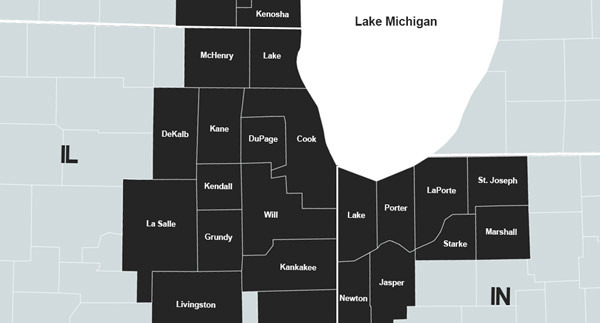
Cook County in Chicago is a region where various industries are actively operating. This massive metropolitan area, with a population of over 5 million, has a high degree of economic independence, with almost all industrial sectors such as finance, logistics, healthcare, tourism, education, and manufacturing evenly distributed.
First and foremost, the center of Cook County's economy is undoubtedly downtown Chicago, known as the Loop. This area is the base for finance and business services, housing the Chicago Mercantile Exchange (CME), the Federal Reserve Bank, large law firms, accounting firms, and consulting companies. Many global corporate headquarters are also located here, with major companies like Boeing, United Airlines, McDonald's, Walgreens, and Molson Coors having their headquarters in Chicago or nearby suburbs.
There are many high-skilled professional jobs, making it a highly competitive business-centric city. The logistics and transportation industries are also key pillars supporting Cook County's economy. Chicago is located at the intersection of rail networks and highways connecting the entire United States, earning it the title of 'America's Transportation Hub.' In particular, O'Hare International Airport is one of the busiest air hubs in the world, handling hundreds of millions of passengers and a massive amount of cargo each year.
Thanks to this, the air logistics, warehousing, and transportation-related industries have rapidly grown, and large logistics centers and industrial complexes have been established in the suburbs. Manufacturing remains an important industrial foundation in Cook County. Once centered on steel and machinery, Chicago has now shifted its focus to high-tech precision manufacturing, food processing, and the biopharmaceutical sector.
In particular, small and medium-sized manufacturers are concentrated in the industrial areas of West and South Chicago, with products produced here distributed across the United States. The service industry cannot be overlooked either. Cook County is home to top medical institutions in the U.S., such as the University of Chicago Medical Center, Northwestern Medical, and Rush University Medical Center, leading to significant development in medical services and the healthcare industry.
Additionally, the education sector is robust. Prestigious universities like the University of Chicago, Northwestern University, and the Illinois Institute of Technology operate as regional research and development (R&D) hubs, promoting the growth of startups and tech companies. The tourism industry is also a major driver of Cook County's economy. Every year, tens of millions of tourists visit attractions like Lake Michigan beaches, the Art Institute of Chicago, Millennium Park, and Navy Pier, generating substantial economic effects on hotels, restaurants, and the entertainment industry.
Even after COVID-19, tourism demand is rapidly recovering, and by 2024, tourism revenue has nearly returned to pre-pandemic levels. Thanks to the balance of various industries, Cook County maintains a relatively stable economic structure despite economic fluctuations.
With a city-type complex economic model connecting corporate headquarters, small and medium-sized manufacturers, innovative startups, and healthcare and educational institutions, it is regarded as a key county that significantly impacts not only the Midwest but the entire U.S. economy.
However, a downside of Cook County is that property and sales taxes are among the highest in the nation, making the cost of living expensive. The southern region has safety concerns and a high crime rate.








 Khan Film Blog Production |
 Illinois Mom |
 Rice Shop Uncle BLOG |
 allstar realty |
 Enjoyable American Life Diary |
  Tonky |
  viroma |
  cookie |
  Live and that's it |
  Alright Twain |
  eatontown blog |
  HAWAII Korean Church News |
  Amore |
  linex |
  Balancework |
  laro90 |
  MEDBIO American Doctor Blog |
  SWAT TEAM BLK |
  DREAM BIG |
  frostbite |
  330 Forever My Love |
  El Dorado |
  dralix58 |
  Gorama Round |
  Skydiving |